abbreviations used:
CC - climate change
GW - global warming
LIA - Little Ice Age
Civilization is at a tipping point. There is now no serious doubt left that mass human die off is a distinct possibility. Overpopulation, environmental destruction, badly managed natural wealth (renewable resources like the ocean fisheries), climate change - all these augment geopolitical instability. Witness the rise of terrorism in recent decades. Mass human die-off is the human equivalent of "ecological overshoot" followed by population collapse which occurs when an organism manages to temporarily overexploit a vital resource, causing a population boom followed by a bust when the resource runs out. Various assumptions about human response to the environmental / demographic crisis naturally lead to different die-off "scenarios": geographical specificity, intensity, duration, possibility of rebound,.. After Rome fell, Western civilization was reborn during the Renaissance eight centuries later. Other civilizations vanished like the dinosaurs. One thing is certain to most (if not all!) thinking people today: we live in a Time of Troubles. These are usually associated with mass human die-off.
A historical example: The onset of the Little Ice Age (LIA). Duration: circa 1300 - 1850. At the beginning of the 14th century: the Renaissance, Europe was urbanizing, the bourgeosie flourished as did commerce, wealth and population. These were the Good Times of the Medieval Climatic Optimum: slighly elevated temperatures, climatic stability and in Europe, generally good, if not superior crop yields. Cultivars migrated northward: olives and wine were grown in England! Microbes migrated too: malaria and leprosy - tropical diseases today - were edemic throughout Europe, as far north as Scandinavia.
But things changed incredibly rapidly, within the span of a few decades, as the LIA slammed into Europe with astounding ferocity.

The early years of the 14th century marked a rapid transition from the Medieval Optimum to the LIA: extreme weather destroyed crops, extensive - and inhabitual - flooding combined with repeated cold waves resulted in many deaths from hypothermia and malnutrition related infections (due to immunosuppression). Then the bubonic plague hit, a newly emergent disease similar to AIDS, Ebola and SARS in our day. New epidemic strains of old diseases are killing the little brown bat of North America and amphibians worldwide. Epidemiologists and ecologists suspect that changing climate plays a role in emergent diseases by modifying host-parasite interaction. Today, for example, we see malaria spreading to regions formerly malaria free as global warming (GW) allows mosquitios to inhabit regions formerly too cold. At any rate, once bubonic plague appeared, its spread was facilitated by extreme weather induced crop failure and mass malnutrition which suppressed human immune systems. (In modern times, it is estimated that malnutrition induced disease kills as many as 10 times the number that initially starve to death.) Waves of "environmental refugees" flooded into towns and cities seeking employment. These mass migrations became "vectors" of bubonic plague transition. Overcrowed, malnourished, immunosuppressed migrants living in unhygenienic conditions were fertile ground for the plague to take root. Those that survived fled - and carried the plague with them. Waves of plague washed over Europe from country to country. A century and a half later, circa 1450, Europe's population had declined by a whopping 25 - 40% according to the experts you consult - at least they concur that it was a Time of Troubles accompanied by mass human die-off, note 1.

The fact that we live in a Time of Troubles is the central fact of our existence today (deny it as we will). If we choose to live authentically, we must accept it (though we quibble over its general significance, personal relevance, timing, outcome..)
One point, though, stands out as capital: we cannot blame fate. Our "fate" was collectively constructed - or "chosen". It was not imposed by God. Undoutedly, evolution played a role in the way our minds work but that simply means we are the products of evolution, not its slaves. A big part of the evolution of the human mind was the development of a "General Problem Solver" which evolved to operate in a relatively context free fashion on all sorts of complicated and ambiguous problems. Above all, humans are endowed with "reflective reason": the capacity to "stand outside ourselves", view our own actions from "above", study their trajectory, postulate where that trajectory will lead and take corrective action, if needed.
It is high time that citizens of democracies reclaim their citizenship from the economic / commercial / financial / industrial / bureaucratic juggernaut which has "stolen" our citizenship, our power and our rights.
Reclaiming citizenship? In democracies citizens are free, equal and bonded in fraternal respect. That's the theory anyway..
Liberty - Equality - Fraternity
Liberté - Égalité - Fraternité
Libertad - Igualidad - Fraternidad
Le Peuple est Roi! The people are the rulers in a democratic regime. The buck stops at the people. If we don't like the state of the world - and we take democracy seriously - the people are responsible for the state of the world. Either the people are King or they are not - you can't have it both ways..
But what do we see today? The "King" - the People - have let themselves be divested of their power by Corporate power and greed (and the influence it buys). My favorite definition of fascism runs:
Fascism: the control or seizure of the State by the Corporate Elite.
We need only think of how mass media control the flow of information and the biases (if not outright lies) they introduce to serve the political and social agenda of their clients (the fossil energy industry, for example). The fossil energy lobby has mounted a somewhat effective compaign against climate science and renewable energy technology. This campaign was not sufficient to block renewable energy development, only slow it significantly (particularly in North America and, by providing a false model of "development", in large third world countries like China and India).
http://transparencycanada.blogspot.ca/2015/08/the-organisation-of-denial-conservative.html
Of course, it is easier to displace blame onto a cabal of Evil Greedies than to step up to the plate and accept responsibility: we, the people, have let ourselves be duped; we have bought into a soul destroying, culture destroying, planet destroying hyper-consumer society. Now the shit is in the fan and we ain't got nobody to blame but ourselves. Easier to blame someone else than give up all the goodies we've gotten ourselves addicted to, eh?
Logical inconsistency in conspiracy theories?
There exists an omnipotent, omniscient - and evil - Universal Conspiracy (names vary) which controls all aspects of our lives and the life of human societies in general.
Since the Universal Conspiracy controls all information flows, the information we have about UC and its doings cannot be trusted. Therefore, we can conclude nothing about UC, even its existence.
When conspiracy theories become dangerous. The most obvious case is when displaced responsibility is shifted to defenseless scapegoats. These are useful to ruling elites because they can be safely abused, temporarily releasing pent up frustration, fear and rage among the masses. Unfortunately, the fix wears off fast so a fresh bout of hate-spew (if not violence) is soon required.
More insidiously, conspiracy theory hate-spew excuses one from taking concrete action in one's personal life and immediate surroundings. This is why you see so much hate-spew on the internet. You get an immediate and potent "hit" or "high" with little real effort, an emotional "bolus" effect, like an injection of your favorite poison or a toke on a crack pipe. Ego gratification is also easily achieved by "unmasking" and hate-smearing Evil Greedies. Community based activism, on the other hand, is slow, demanding, often more ego-bruising than ego-stroking. Ultimately, conspiracy theories are another "last resort of the powerless" (or those who see themselves as such, whether it is admitted or not). In a similar vein: "cynicism is the last resort of the powerless" (unknown source).
The psychology of powerlessness and the lure of authoritarianism. What can finite, feeble, isolated, anomic wo/man do, facing such a protean, polymorphic Force of Evil? Raised as a traditional - if not reactionary - "christian", I recognize the situation of mankind facing the Ultimate Enemy, Satan, his power and his legions of evil spirits. The solution (I was) offered by the Church was to throw ourselves at the feet of God, beg his Mercy and Forgiveness and "seek to offend Him no more, obey Him in all things". Such views are often linked to the Authoritarian Personality as is the the most extreme form, fatalism, the belief that we are powerless before destiny.
"Another trait which is common to all authoritarian thinking,.. typical of authoritarian character, is the conviction that life
is determined by forces outside the person, outside his interests and
wishes, and that the only possible happiness consists in submission to
these forces."
http://www.cepsr.com/clanek.php?ID=328
For the classical work on the Authoritarian Personality (Adorno et al):
https://en.wikipedia.org/wiki/The_Authoritarian_Personality
So, then, are conspiracy theorists, CC / GW "sceptics" and deniers really closet authoritarians (consciously or consciously) seeking a Führer to submit to? Do they seek an embodiment of Absolute Good who will, in turn, give them a mandate to brutalize (evil) scapegoats with a clear conscience? (note 2)
Personal experience suggests this might be so as do many observable tics and character traits shared in common with the classical Authoritarian Personality type (see especially the original work by Adorno et al - above link):
- stereotypy: individuals are judged collectively according to the group they belong to, not as individuals,
- black / white (dichotomous) thinking: "You're either with us or you're against us" - George W Bush. The world is divided into warring camps, no nuance (or alternatives) permitted. One side, "ours", is all Good, the other, "theirs" is the Incarnation of Evil.
- vilification, viturperation, denigration ("hate-spew"): CC /GW "sceptics" and deniers do not "debate" atmospheric physics, they spew hate. This was a major trait of authoritarians (nazi sympathizers) observed by Adorno et al: The Authoritarian Personality.
- fatalism: we are controlled by external forces. These are evil in nature. Our sole salvation - if there is salvation - is to submit to a force of Absolute Good (God or the Führer) who will guide us on the Right (and only right) Path.
- hypocrisy: clinical testing of high scorers on the "A-Test" (Authoritarin Scale) showed a "poorly integrated", "polyfacetted" personality structure. A "fractured" personality with poorly communicating parts (in extreme cases, on could speak of latent sub-personalities). The right hand did not know what the left hand did (and might not "want" to know - in the Freudian sense, a willful or self-interested ignorance). The authoritarian is often seen by others as hypocritical (perhaps manipulative and uncaring if a position of authority). Authoritarians accuse the groups they hate of the very traits and actions that are so evident in their own characters and actions. CC / GW "sceptics" and deniers abuse climate scientist of "cherry picking" data that fits their theories but one can find few greater cherry harvesters than the "sceptics" and deniers themselves!
- scapegoating: high A-Test scorers show a greater need to find scapegoats to blame for all that's wrong with the world. Given the chance to work out their aggressiveness, some find great zest and pleasure (sadism).
- paranoia: trust does not flow easily. Few are trusted, the worst is always seen or sought for. The world is a hostile place, full of evil and - of course! - conspiracies.
- jargonized speech: authoritarians often spout a weird, emotionally charged jargon. Warning! Professions and specialized branches of study - medicine, mathematics, philosophy.. - naturally develop specialized jargon ("shop talk") to communicate more effectively with their peers. Terms like "velocity" in physics don't have the same meaning as they do in ordinary usage: velocity in physics refers to the speed on an object relative to some reference point and includes the direction the object is moving in (relative to some frame of reference).
The jargonized speech of authoritarians, though, seems intended either to obscure or to manipulate (or both). In a foundational document (Party Platform), published in September 1919, the Fascist Party of Italy put forth the principle that reasoned thinking (or debate) on political issues was to be short-circuited by linking hot-button words (communist traitor, Reds, pinkos, liberal, secular humanist, faggot, the N word,..) to individuals, groups, political positions and social policies. The goal is to mobilized the masses through demagogy. Donald Trump provides a good contemporary example of this use of hot button, emotionally charge hate-spew..
- obsessional concern with social rank and convention: a trait well exemplified by many US Republicans (especially the conservative wing of the party). These folks are also more likely than Democrats (especially liberal Democrats) to deny CC / GW. They often attribute CC / GW with a plot to create a Socialist State (often centered in the United Nations). Many of those folks would seem to conform to light or moderate Athoritarian Personality Type profiles. However, I've observed that some of the flakier conspiracy theorists (professing belief in multiple - sometimes mutually exclusive - conspiracies) present a somewhat modified attitudinal profile. These "hard-core" conspiracy theorists openly flaunt their non-conformism and marginality. They flatter themselves as "counter-cultural". They seem little concerned with adapting to conventional norms. Are they simply variants of the Authoritarian Personality? Are they non-Authoritarians because they lack an essential trait? I am not sufficiently versed in social research to answer that question. (I intend to discuss this issue with a couple of psychologists, though..)
Aside: It is an interesting and informative exercise to apply these criteria to the Right Wing types making so much noise of late: Stephen Harper and many of the people around him, Donald Trump and other GOP luminaries in the presidential race (USA).
What the long term effects of conspiracy theories, GW / CC denial, etc might be, one thing can be said of their practical effects in the here-and-now. They rationalize / justify maintaining the status-quo which, for many middle (especially upper midddle) class Occidentals, still ain't so bad, compared to the Third World or our own poor. Conspiracy theories functionally deresponsibilize a still relatively comfortable - but increasingly skittish - citizenry from reclaiming personal responsibility for the state the world is in.
Yet, if society is to "advance", or more modestly, if only a surviving fraction of humanity is to have a chance of flourishing, the citizen must reclaim the right, duties and responsibility of Citizenship.
http://transparencycanada.blogspot.ca/2014/08/four-pillars-of-sustainable-economy.html
notes:
1- If we take the midpont of the above estimated range (25 - 40% die off), we obtain a 33% mortality. One out of three Europeans died between, say, 1300 and 1450 due to famine, plague, flood, hypothermia, malnutrition induced disease and their various combinations. However, this 1 in 3 figure surely underestimates the impact of the CC induced disaster. It represents the decline in population relative to the value attained circa 1300. In reality. population was "flourishing" - by Medieval standards - in 1300 and so the real impact should be measured against this rising trend and the value population would have reached if the LIA and plague had not intervened. If we consider the (hypothetical) case of a modest 2% population growth rate per decade for the period 1300 - 1450, we achieve a "business-as-usual" projected population increase of 34.5% between these two dates. Crunching these figures gives a more realistic die-off ratio of 1 in 2. That is, population declined by 50% compared to the value it would have reached if the Good Times of the Medieval Climatic Optimum had continued.
(1.345 - .67) / 1.345 = .5
1.345 is the ratio of the "business-as-usual" projected population for 1450 compared to the real population of the baseline year 1300. The ratio of the real population in 1450 compared to the baseline is .67 (signifying a real population decline of 33%). The numerator 1.345 - .67, or .675, is the difference between the real population in 1450 and the population projected if the Good Times of the Medieval Climatic Optimum had continued.
2- sceptic: original meaning versus use by CC / GW "sceptics". The term has its origins in Greek philosophy. Today, there are a variety of usages, sometimes contradictory. The following is the one at most variance with the attitude of most CC / GW "sceptics" I've met:
" methodological skepticism is an approach that subjects all knowledge
claims to scrutiny with the goal of sorting out true from false claims"
https://en.wikipedia.org/wiki/Philosophical_skepticism
In contradistinction, CC / GW "sceptics" are ideologues who possess The Truth: CC / GW are lies concocted by the Evil Greedies in order to do evil things. Example: pro-GW college professors plot to make "trillions" off carbon credit trading - ignoring, of course, all those oil company CEOs and investors who risk losing millions or billlions if decentralized, locally controlled, renewable energy systems were to be widely developed!
So why is Donald Trump winning the Republican nomination in the run up to the US Presidential election? He's vulgar, brash, narcissistic, racist, misogynist, a born rich billionaire businessman with a lousy labor relations record and he appeals to blue collar voters.. What in Hades is going on? And why did the media and liberal political pundits not see this coming? (Aren't they payed to read the entrails of the political beast?)
Iconoclastic political analyst Thomas Frank was recently interviewed by Anna Maria Tremonti on the Canadian Broadcasting Corporation program, "The Current". Frank shares a view with myself on why Trump is trumping all comers and why the liberal media and commentators got it all wrong.
Frank's hypothesis is simple. The free trade agreements of the last four decades - beginning with the opening of trade with China under the Nixon administration - have not benefited the American working class. Of course they didn't! They were proposed by multinational corporations and enacted by compliant Western governments mesmerized by Free Market ideology in order to maximize the profits of the multinationals. Workers in the industrialized world were played off against cheap labor in the third world. The result: off shoring of blue collar (and some lower echelon white collar) jobs to third world countries with low wages, few social safety nets, poor - sometimes horrific - working conditions and little environmental protection legislation. North American workers have payed heavily for the North American Free Trade Agreement: ask Canadian, American and (even!) Mexican workers. Workers have payed with unemployment (and all the miseries it entails), wage stagnation (hence effective wage roll backs due to inflation), real wage roll backs, loss of benefits and job precarity. Many who lost good paying blue collar jobs have been forced to accept precarious, low wage "Mcjobs" in service industries, slapping hamburgers or selling cheap, inferior quality made-in-China ware. Many have retrained and become self-employed contract workers (some have done well, others not so..) But it is the rich who really benefited from Free Trade and, to a large degree, so did the upper middle class (professionals). And that's all that really matters for neoconservative Free Market ideology..
Frank is "iconoclastic" in the sense that he has chosen to see what the self-imposed tunnel vision of the liberal media, pundits and politicians has prevented them from seeing. The blue collars are mad, really mad; they've been frustrated for a long time, no one has listened to them. They see the American dream steadily retreat. Many families require two adults working either to have a crack at the American dream (sending their kids to college) or simply to make ends meet. In both Canada and the US, parties from both sides of the political spectrum - mesmerized by the neoconservative Free Market ideology - have implemented Free Trade deals on the backs of the laboring masses, even against their wishes (Canada).
The (demonic) genius of Trump is his demogogic appeal to the anger, frustration, fear and humiliation of the common people. He projects the meme of deep and abiding solidarity with their anger, frustration, fear and humiliation. The liberals and the Democrats, says Frank, have lost contact with the "masses" long ago. Over the years, more and more blue collars vote Republican. The Democrats are no longer the Party of the People. But Trump knows how to stir up and then ride the wave of rage and bottled up frustration and fear. And this, says Frank, is why Trump trumps his opponents who are seen as part of the Establishment that hold the common folk in deep contempt.
The following is the podcast of the CBC interview with author Thomas Frank (16 March, 2016):
http://podcast.cbc.ca/mp3/podcasts/current_20160316_45599.mp3
Analysis of an evil, corrupt system: the source of blue collar rage. Various versions of the Carrier air conditioner company layoff video have been seen by about 3 million youtube viewers - yet it was published only a MONTH ago! According to Frank, a very popular video with Donald Trump supporters.
https://www.youtube.com/watch?v=M3-s72NToTw
Thomas Frank's most recent book - hot off the press - on what's wrong with the American Left (or "what passes for the Left in America" as he put it in the interview with Anna Maria Tremonti).
http://us.macmillan.com/listenliberal/thomasfrank
Frank has published several studies of the rise of the New Right in America. Google Thomas Frank for more titles.
https://www.google.ca/?gws_rd=ssl#q=thomas+frank+book
Sébastien Steyer: Earth before the dinosaurs, Indiana University Press, 2012, 173 pages; profusely illustrated: photos, paintings, sketches; bibliography, index.
The magnificent artwork and sketches are by Alain Bénéteau
abbreviation used in this article:
- mya: million years ago (before the present)
I originally decided not to review this exasperating - and wonderful - book: too small a potential audience, too specialized, too technical, some serious pedagogical issues..
 However, perhaps against better judgement, here 'tis. Ultimately I was moved to write because I love the book and hope that a few readers will decide to check it out at their local library and enjoy it as thoroughly as I did. (If your library doesn't have it, recommend it to the holdings department. Most libraries welcome suggestions. I suggest several books per year and have been refused only twice. This way you get to read a good book for free and assure that others will have the chance to read it too.)
Subject: Early tetrapod (four-legged animal) evolution from the Devonian to the Permian mass extinction, 416 - 250 million years ago (mya). This is our history, human history, in deep time since humans are mammals and mammals are modern representatives of tetrapoda, the four-legged tribe.
The image above is hynerpteton, a Late Devonian tetrapod, 360 mya. Hynerpeton was an aquatic carnivore living in coastal mangroves, capable of limited motility on land (like a modern walrus or seal). Its primary mode of propulsion was the large tadpole tail, visible in juvenile frogs and the embryos of terrestrial vertebrates.
Before the dinos was originally published in French. Chris Spence, an ex-patriate American living in Paris, deserves due credit for the quality of the translation. I had no impression whatsoever that the text had been composed in a language other than English. Good job, Chris! The only gaffe I found was the translation of the Canadian province, Novia Scotia as "New Scotland"! Quite an odd error for a professional translator..
It is rare that science books, especially highly technical ones, are considered "beautiful" (as one reviewer was moved to remark). The quality of the artwork, in fact, moved me to undertake this review. At times it is stunning. The illustrator, Alain Bénétau, prefers dramatic "cloud-wracked" skies, threatening storm. On the whole the images are far more life-like (hence interesting) than one would expect for an academic work.
However, perhaps against better judgement, here 'tis. Ultimately I was moved to write because I love the book and hope that a few readers will decide to check it out at their local library and enjoy it as thoroughly as I did. (If your library doesn't have it, recommend it to the holdings department. Most libraries welcome suggestions. I suggest several books per year and have been refused only twice. This way you get to read a good book for free and assure that others will have the chance to read it too.)
Subject: Early tetrapod (four-legged animal) evolution from the Devonian to the Permian mass extinction, 416 - 250 million years ago (mya). This is our history, human history, in deep time since humans are mammals and mammals are modern representatives of tetrapoda, the four-legged tribe.
The image above is hynerpteton, a Late Devonian tetrapod, 360 mya. Hynerpeton was an aquatic carnivore living in coastal mangroves, capable of limited motility on land (like a modern walrus or seal). Its primary mode of propulsion was the large tadpole tail, visible in juvenile frogs and the embryos of terrestrial vertebrates.
Before the dinos was originally published in French. Chris Spence, an ex-patriate American living in Paris, deserves due credit for the quality of the translation. I had no impression whatsoever that the text had been composed in a language other than English. Good job, Chris! The only gaffe I found was the translation of the Canadian province, Novia Scotia as "New Scotland"! Quite an odd error for a professional translator..
It is rare that science books, especially highly technical ones, are considered "beautiful" (as one reviewer was moved to remark). The quality of the artwork, in fact, moved me to undertake this review. At times it is stunning. The illustrator, Alain Bénétau, prefers dramatic "cloud-wracked" skies, threatening storm. On the whole the images are far more life-like (hence interesting) than one would expect for an academic work.
Eusthenopteron: 385 million years ago, Devonian. A "transitional" fish with some characters of land animals. Note all those fins! Two of the lower pairs developed into tetrapod legs. The above two images are from Before the dinos.
Some of the images achieve a quasi-photographic quality to the point one can imagine one is looking at a photo of an exotic rain forest critter in National Geographic. The image of archaeothyris, 310 mya, the "oldest known synapsid" (the ancient genetic lineage of which mammals are the sole survivors) could fool most people,passing off as a photo of a somewhat scary looking modern reptile, 20 inches in length.
The visuals are the book's strongest point. It is literally jammed full of images of all sorts: paintings, sketches and photos, body silhouettes, several per page. Many are photos / sketches of fossils, including in situ photos before removal and preparation of the fossil for display. Fossil photos are generally accompanied with one or more sketches outlining anatomical features of evolutionary importance. I found these a pleasant way to deepen both my knowledge and appreciation of early vertebrate evolution.
Ichthyostega (top) and acanthostega: early tetrapods. Ichthyostega had a robust shoulder girdle and front limbs which allowed it to hump about on land by alternately scrunching up its tail to push forward and then using its powerful front limbs to push back (the hindlimbs were useful for swimming only: too short and badly angled to walk with. Fossilized races of body dragging as described above are found in places where ichthyostega was abundant. Acanthostega (bottom), also an early tetrapod, was not to any degree adapted for locomotion on land).
The biggest, most glaring flaw of Before the dinos is the absence of a technical glossary: absurd for such a technical and highly specialized text, and particularly for one with pretentions of a larger readership. The quality artwork does, in fact, suggests an attempt to appeal to a larger readership, an impression furthered by the blurb on the front and back covers of the original French edition. In addition, prof Steyer included photos of field working conditions and modern paleontological technology (scanners, radio-isotopes..) both of which would be irrelevant if the intended readership was purely an academic or professional one. He also waxes idylically about the pleasures of a career in paleontology on several occasions: also irrelevant for a professional readership. The lack of an adequate glossary is thus as puzzling as it is irritating. I was eventually reduced to inserting book marks in places where technical terms were defined so I could flip back to refresh my memory when I got bogged down in a particularly dense thicket of technical verbiage: ichthyan sarcopterygian versus tetrapodomorph sarcopterygian for example (!!!) C'mon prof Steyer, give the reader a break..
Ichthyostega seizing prey 360 mya in a Devonian coastal mangrove. Note the submerged tree trunk..
History of the tetrapods, the four legged tribe: This history displays the strong dependence of organisms upon their environment and, by inference, the impact of the physical environment on biological evolution. (see footnote 1). Way back in the Paleozoic (early life) earth, the moon was much closer than it is today. This increases the gravitational forces raising tides. In addition, the earth rotated a bit faster, further increasing tidal forces and raising higher tides. The result was that the intertidal zones, the land impacted by daily incursions of tides, were much larger than today's intertidal zones. Marine mangrove ecosystems - intertidal forests - were much, much more extensive and diversified than today.
modern mangrove, where sea and forest meet
Paleozoic mangroves provided a rich, diversified, "fractally broken" network of partially interacting "microclimates", very favorable to evolutionary experimentation and diversification. (note 2) In this perspective the early tetrapods can be seen as highly mutant fish, intermediate in form and function to both fish and land animals. Thus tetrapods, as a group, possessed both lungs and gills. But why lungs?
In the light of current knowledge, lungs did not evolve in some attempt to "conquer the land". It is likely that they were used for dealing with oxygen impoverished water. The large intertidal zones of the Paleozoic, circa 350 - 400 mya, would have been characterized by very high tidal velocities, compared to today's oceans. This is reflected in the large amount of fossilized plant "litter" found in Paleozoic mangrove sites. The litter would have provided nutrients for abundant bacterial blooms, particularly on warmer, subtropical and tropical seacoasts. The bacterial blooms would have de-oxygenated the water, necessitating the evolution of a backup system of respiration: swim bladders modified to serve as lungs. The development of air-breathing was not, therefore, an adaptation to life on land or a "stage" in the "conquest of the land". Lungs and air-breathing were merely an adaptation to an oxygen deprived aquatic environment. Then, since life is opportunistic, only later did some of the critters re-adapt their capacity to breathe air to spend more time on land. The "fractally broken" mangrove, comprised of alternating stretches of shallow swamp and land, could be better exploited by amphibious tetrapods capable of negotiating short stretches of terra firma separating adjacent swamps. They were still aquatic predators: living on the land "for real" would only come aeons later.
Chiridian limbs, you say? The greatest innovation of the tetrapods, when they were still aquatic (be it noted), was probably "chiridian limbs". These are the limbs of land animals (including cetaceans - whales and dolphins - who returned to the sea). The primary feature of interest here is the termination of chiridian limbs in bony digits as opposed to the cartilaginous rays typical of fishes. See graphic below. Typically, the early aquatic tetrapods and tetrapodomorphs ("close-to-tetrapods"), had 6, 7, or 8 digits per limb, probably reflecting their usage in swimming (big webbed foot to displace a lot of water at each stroke).
Ichthyostega and the beginning of chiridian limbs, the word "rayons" in the leftmost limb sketch is French for the cartilaginous rays of fish fins. Panderichthys shows a curious hybrid form found in some early tetrapodomorphs: the bones of the limb are analogous those of land animals (modern tetrapods) while the cartilaginous rays are typical of modern fish!! A "missing link" (sort of).. Click on the image for a larger more readable version.
In reality, no one knows for sure why chiridian limbs evolved in the first place: no one can identify the "selective pressure" driving their evolution. The very earliest chiridian limbs appear on critters whose anatomy did not permit them to crawl about on land. (When critters began spending some time on land, then chiridian limbs, with their robust terminations did indeed prove useful - but they did not evolve for that purpose.) Prof Steyer proposes that they might have been used for seizing and holding the female during mating but admits this is pure speculation.

Another suggestion I have come across: chiridian limbs allowed tetrapod predators to sneak up on their prey, walking along the cluttered bottoms of mangrove swamps, concealed by bacterial bloom clouded water. Their prey, like other fish, would have possessed "lateral lines" with sensory endings designed to detected the vibrations set up by the fins of approaching predators. Sneak-walking along the bottom would have produced less low frequency vibrations than swimming. Another possibility (from myself): some of the early tetrapodomorphs and tetrapods have flattened bodies and eyes on the backs of their heads. This suggests that they concealed themselves on the bottom waiting for prey to come by. If so, they could have used their chiridian limbs as shovels and fans to spread mud and fine sand over themselves for concealment..
Missing links - real or imaginary? Prof Steyer rejects the notion of evolutionary "missing links" because, he believes, evolution has no goal, no final purpose. There is no "plan" directing evolution "from" species A to B to C with B the "missing link" between an earlier, more "primitive" form, A, and the "more evolved" form, C. In reality, Steyer argues, when we speak of missing links we are confounding familial likeness with an ordered (intentional) sequence of steps. Similarity in the fossil record merely reflects genetic descendance, not the unfolding of an "evolutionary project".
From Steyer's "democratic" interpretation of evolution, each species is its own "goal" in the sense that its members seek to survive an propagate their kind. In this perspective, humans are not really "superior" to other life forms. Rather, each form of life possesses its own specificities, its own "essence" or mode of "being-in-the world". Its specificity allows a species to occupy / create an ecological niche which it will occupy until changing environmental / ecological conditions render it "obsolete" and it will be replaced. Ichthyostega was not a "stage" on the road to becoming-human. It was not even out to "conquer the land". Its chiridian limbs provided some mobility on terra firma, allowing this predator to extend its hunting range. It could cross a stretch of dry land to get to the next wet piece of mangrove swamp. With improved mobility, it prospered until environmental conditions changed or until a competitor better adapted to its environment appeared. The only reason ichthyostega bears features in common with tetrapods, mammals and humans is because it belonged to a successful group of species that left descendants, including ourselves. Ichthyostega was merely doing its thing: predating, fleeing, fighting mating, not "striving" to give birth to humanity, a third of a billion years later..
Comment: In principle, prof Steyer is - most likely - correct in denying an overall purpose or identifiable goal in biological evolution (at least as a first approximation to reality). Nevertheless, this should not blind us to the possibility - the likelihood! - that certain "evolutionary strategies" prove more successful than others. Thus vertebrate evolution has established several lineages (birds and mammals) in which "cephalization" has proven a successful "strategy" over time. The brain becomes larger and more complex despite the enormous drain on metabolic resources (oxygen, energy) required to maintain a large brain. The increased behavioral adaptability a large brain permits can, in some environments, offset the increased metabolic demands of feeding a big brain. Minaturization is possibly another emerging evolutionary trait in vertebrates. As the nervous system evolves, cooperation between increasingly intelligent individuals becomes increasingly advantageous from a survival standpoint: two heads are better than one (especially if both are smart..). In this scenario, cooperating individuals have a lowered mortality, hence greater ability to pass their smart genes on to offspring. Each generation will, infinitesimally, tend to be brighter than the previous. Now, this situation generates "selective pressure" for greater population densities: a denser population permits more cooperative interactions between individuals. Unfortunately, natural ecosystems can only feed so many individual per square hectare. A way around this bottle neck - a new "selective pressure"! - is to reduce the average size of individuals thus allowing a greater population density for the same amount of food consumed. If the competitiveness of the species is improved, selection will lead, over time, to smarter, smaller individuals. Some evolutionists believe there is evidence for such miniaturization of modern, highly cephalized vertebrates.

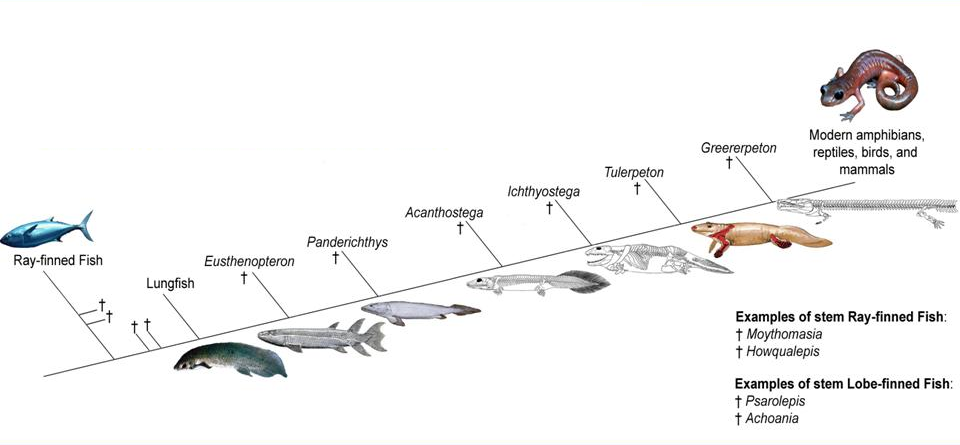
How modern tetrapods, upper right, are related to fish, left. All the critters between lung fish and modern tetrapods - "the missing links" - have gone extinct.. Again, click on the image for a more readable enlargement.
Coelurosauravus and fossil. A glider, not a true flier.
Moradisaurus grandis, late Permian herbivorous reptile
Note the large defensive talons - "don't mess with me!"
notes:
1- Climate change as a - or the - major "driver" of bilogical evolution on earth:
internal blog links: keywords: science, book review, climate change
http://transparencycanada.blogspot.ca/2015/07/book-review-catastrophes-and-lesser.html
http://transparencycanada.blogspot.ca/2015/02/book-review-everything-you-wanted-to.html
http://transparencycanada.blogspot.ca/2014/08/book-review-end-of-world-at-end-of-world.html
http://transparencycanada.blogspot.ca/2013/11/book-review-great-extinctions-what.html
http://transparencycanada.blogspot.ca/2013/05/book-review-ice-ages-solving-mystery.html
2- The following quote is from a recent book review of a text on Disturbance Ecology which deals with the biological diversity fostered by fragmented, frequently disturbed ecosystems:
"Disturbances
help generate the mosaic makeup of the habitat. A fire burns out a
patch of forest and open it up to sunlight. Now, small plants, which had
been suppressed by the shade of the trees, can thrive, and then a
meadow can develop. Every organism is uniquely adapted to a particular
type of habitat and a diverse array of habitats can support many more
species than a uniform habitat. A variety of habitat patches, in turn,
supports a diversity of species and communities. This biodiversity is the foundation of the natural ecosystem services upon which all life depends.
Contrary to common thinking, disturbances are not bad, but rather they
are valuable - indeed, they are essential for healthy ecosystems.. The
nature of nature is change."
http://transparencycanada.blogspot.ca/2016/01/book-review-disaster-ecology-bright.html?spref=fb