Abbreviations used:
CC - climate change
CO2 - carbon dioxide, a major greenhouse gas (GHG) responsible for global warming (GW)
GHG - greenhouse gases. Gases like carbon dioxide and methane which trap outgoing infrared radiation (heat) thus contributing to global warming. GHG act like an insulating layer: the more there are, the better the insulation and the hotter the earth gets.
GW - global warming
Each of our action produces unintended consequences. Some of these consequences are beneficial; others, not so much.. (Edgar Morin: La Méthode, "écologie de l'action)
In thinking about the trajectory the world is following - ecocidal, suicidal -, I am led to reflect on the role that neoconservative values, ideology and hubris play in the unfolding tragedy. Neocons adulate the Brash and the Bold, the iconoclasts, the mavericks and scofflaws: Donald Trump, the Philippines' homicidal macho president Rodrigo Duterte, France's Islamophobic populist Marine Le Pen, Nigel Farage of Brexit (in)fame. You get the picture: the folks who love to strut their political incorrectness (and gain popularity and votes doing so).
Let's hope Honest Abe was right..
http://transparencycanada.blogspot.ca/2017/06/b-ook-review-corey-robin-reactionary.html
I believe this political attitude can be legitimately seen as an extension, intensification (or degeneration) of the hubris of Western European Christian culture. Five centuries ago, Christian Europe arrogantly assumed the role of converting the "lost souls" outside Europe to the One True Faith. Over time, the power of the Church dwindled, the mask fell away, revealing economic exploitation - and the political leverage it brought - as the true goals.
Today, the folly of this approach to running a planet is becoming evident. Global warming (GW), due to the greenhouse gas (GHG) emissions of human industry, transport and industrialized agriculture, threatens the world's major food production centers. Terrorism and war wait in the wings. The traditional horsemen of the apocalypse: famine, plague and war.. or - more cynically - "Mother Nature's birth regulation program"..
It is now becoming clear, that in order to survive and thrive, human societies should act to minimize the production of "unknown unknowns". (We except those hardy individuals who select themselves as "expendable", who deliberately adopt risky occupations, for example, astronauts, soldiers, doctors fighting ebola epidemics, firefighters. There are legitimate risks that need to be taken and someone has to take them!) Unknown unknowns are the most troublesome unknowns, the ones we are ignorant of. Such unknowns generally emerge and become impactful when a system (ecosystem, social system, organism, enterprise..) is pushed beyond the normal range of values it was designed to function in. Known unknowns, on the other hand, are the one's we have learned to live with like the natural seasonal variations in temperature and storm risk. In principle we can adapt our behaviors to the expected range of variation of known unknowns. We put aside light jackets and sweaters as well as raincoats and umbrellas to deal with the (known, expected) variations in spring and fall weather. For winter, we put aside snow shovels, heavy boots, salt and sand.
When it comes to the health of essential ecosystem services, to maintaining climate stability, or the potential for ethnoracial conflict, we should act, collectively, so that the primary unknowns society has to deal with are known unknowns. In particular, we should avoid pushing vital systems - upon which our lives depend - outside the normal range of operating values they were designed (or evolved) to handle. Such wise policies would, for example, stabilize GHG emissions to minimize nasty (unexpected) surprises in the functioning of vital climatic systems and large regional ecosystems.
A prophecy: it is now too late to avoid Imminent Mass Human Die Off (IMHDO). Put bluntly - the world is screwed (note 1). I predict (going out on a limb here) that it is now too late to stabilize global warming within 1, 1.5, 2 degree Celsius (or whatever the limit of the month is..) A Permian style meltdown of polar region carbon stores has begun, reinforced by powerful positive feed backs (note 2). If the brakes on greenhouse gas emission were slammed on hard, there is a decent chance the planet would move back from a transition to a decidedly warmer global climate. However, this would just be good luck. It is just as likely, if not more so, that "rising living standards" will continue to pump up greenhouse gas levels and that Gaia, the planetary ecosystem, will soon tip into a warmer climatic submode (note 3). Perhaps future generations will live on an earth warmer by 4 or 5 C compared to the world we live in today. Portions of the world could actually become too hot to sustain human life before the century is over.
http://www.dw.com/en/climate-change-could-make-south-asia-too-hot-for-human-survival-by-2100/a-39944935
A wounded earth would then - eventually - slide into the next Ice Age. The warmest portion of the present Interglacial warm period, the hypsitherm, occurred several thousand years ago. We should be cooling off now, slowly sliding into the next glacial era. It is interesting to note that the earth was, in fact, beginning to cool off until the industrial revolution came along and began pumping all those GHG into the atmosphere. The collapse of industrial civilization and global population will, one presumes, allow natural Ice Age dynamics to re-instate themselves. A diminished humanity living on an ecologically diminished earth will encounter the challenges of the next Ice Age with diminished technological capacity to adapt. A Karmic payback, one images, for our arrogance, inflation and hubris.
"As a man sows, so shall he reap" - Jesus
"As you sow the
seed so shall you reap the fruit." - Buddha
God/dess knows how the combined impacts of species extinction, ecosystem service destruction, and planetary overheating will affect the dynamics of the next Ice Age. Would a damaged earth experience a harsher than normal Ice Age? Or would it be delayed and shortened in length because of all the GHG? At this stage of the game, it is anyone's guess - unknown unknowns!
Yes, indeedy, the world is a ball of confusion - and our current (failing) culture is only making things worse. Please take a few minutes to read these wise words.
http://milwaukeereflections.blogspot.ca/2017/08/writing-in-end-times-comprehensive.html
Can anything be done to stave off the impending collapse (or, at least, mitigate its effects)?
dodging-extinction-part-3-what-can-we-do
I also strongly recommend the following two "experimental" novels by our friend Don Hayward. These explore how the collapse of industrial society might unfold in Ontario providence, Canada, and how a new civilization based on respect for Earth, cooperation and local production and governance could arise (if we are lucky).
Hayward: after-the-last-day
Hayward: the-seventh-path
notes:
1- Note that I wrote "the world is screwed", not "the earth is screwed". The earth, the planet, and the life thereof will survive. We may succeed in damaging the earth's ecosystems to the point that all vertebrates - including ourselves - go extinct (an extremely unlikely proposition!) Nevertheless, insects, plants and bacteria (including primitive bacteria living buried miles deep in rock under the sea floor) would survive.
By "world" I mean a civilizational or cultural perspective on the human condition. A "world" - the Late Classical world of the Mediterranean or the world of the Inuit (Eskimos) before the arrival of Europeans - arises from the interaction of human imagination and the biological and physical world in which that human spirit is immersed and from which it arises. Whether or not humanity goes extinct, our present "World" is dead meat because it is ecologically and demographically unviable, unsustainable.
2- The Permian mass extinction event, 250 million years ago, was the worst: more than 90% of plant and animal species on land and sea went extinct. This mass extinction bears creepy similarities to what is happening to our earth today. Then, as today, massive releases of GHG caused planet-wide GW. The only difference is that then the GHG were due to vast subcontinental volcanic eruptive zones (the Siberian Traps), today the GHG are due to human economic and agricultural activity.
One of the most disquieting similarities relates to the nature of the actual kill mechanisms. The initial Permian volcanic GHG emissions warmed polar regions. This caused permafrost to thaw and decompose, releasing massive quantities of GHG (CO2 and methane). These new emissions amplified the initial GHG warming (positive feedback loop). In addition, methane - an even more potent GHG than CO2 - was released in industrial quantities as buried methane containing ice thawed in shallow polar coastal waters. It is this second pulse of GHG that is generally accepted today as the knock out punch that did most of the killing. In addition, Late Permian ocean waters became stratified (reducing the vertical circulation that oxygenates deep water) and acidified (from atmospheric CO2 absorption and seabed methane release). Life disappeared from large regions of the oceans as toxic anoxic (no oxygen) zones spread. Now, all these kill mechanisms are becoming active today: permafrost is rapidly melting, methane ice in shallow coastal waters is thawing and releasing methane, anoxic zones are spreading..
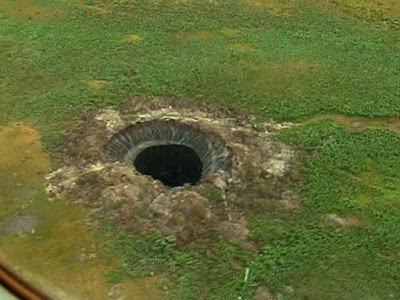
massive Arctic methane blow hole, Siberia (aerial photo)
Close up of blow hole. Note tiny human figures on upper rim (left side)
3- Ice Ages are periods of about 100,000 years in which global temperatures drop by about 5 C or more. These are separated by shorter Interglacial warm periods lasting several tens of thousand of years. The current Ice Age / Interglacial periodicity is a relatively recent phenomenon in earth's climatic history. It is due to the current patterns of deep water ocean circulation arising from the joining of North and South America about two million years ago.
https://en.wikipedia.org/wiki/Ice_age
Not all Ice Ages and Interglacials are created equal! Some Ice Ages are colder than others, some Interglacials are warmer than others. If Ice Ages and Interglacials are two dominant modes that the earth's climate systems swing through then Ice Ages and Interglacials possess several sub-modes. It is conceivable that our current GHG emissions might "pop" our current climate system into a warmer sub-mode. An analog to the world we are probably headed toward would be the last Interglacial (Eemian) when hippopotamuses waddled in the Thames and Rhine rivers while forests grew on what is now arctic tundra.
https://en.wikipedia.org/wiki/Eemian
Michael Benton: When Life Nearly Died (Thames and Hudson, 3rd edition, revised, 2015), 313 pages, glossary, index, chapter notes, bibliography, numerous illustrations.
abbreviations used in this article:
CO2: carbon dioxide, a greenhouse gas causing global warming
GHG: greenhouse gas
GW: global warming
mya: millions of years ago
The Late Permian Mass Extinction event, 250 mya, was the greatest. It was caused by massive volcanic release of greenhouse gases (GHG), overheating the earth and driving most animal and plant species on land and sea to extinction. The current human induced extinction rate is believed to largely exceed that of the Late Permian extinction.
When Life Nearly Died or everything you wanted to know about mass extinctions were afraid to ask. One of the most pleasantly readable, complete and up to date texts accessible to the general reader. Reads like a historical novel. Definitely recommended.
This text covers the modern history of evolutionary theory with special emphasis on the spectacular advances in our understanding of mass extinction mechanisms, their impacts, duration and timing which have occurred over the last fifty years.
Estemmenosuchus-mirabilis: the only known omnivore with antlers. Body of a hippo, antlers of a moose, muzzle of a sabre tooth tiger - a veritable chimeric monster! An early - Permian age - member of the synapsid clad (genetic group) which gave rise to mammals.
Traditionally, the appearance and evolution of life on earth were framed within a biblical understanding of the origin of the world. During the Industrial Revolution mining activity increased, bringing to light many fossils which were studied and classified by by students of the emerging earth sciences: geology, paleontology, ecology, climatology and evolutionary biology. European scientists soon realized that the Earth had to much older than the chronology presented in the Old Testament. The fossils were records of life in earlier aeons of Earth's existence. But how old is the Earth?
Over time, a pattern of "gaps" in the fossil record emerged. Gaps in fossil chronologies appeared everywhere - they are the rule, in effect. The "fossil record" - the chronology of biological evolution as recorded in successive rock strata - is a series of fragmentary chronologies of biogeological history broken by changes in topology of the earth's surface and seafloors. Regions of upthrusting mountains will expose seabeds to the atmosphere and to erosion by rain, river flows and windborne sand particles. Overtime, the former seabed will erode exposing increasingly older sediments (and the fossils they contain).
sedimentary fossil formation: click on image to enlarge
A big part of the work of geologists and paleontologists is to match segments of rock strata from different parts of the globe to create a Universal Earth History. Some types of fossils are extremely useful in constructing this History. A critter which lived for several tens of millions of years and was widespread provides a sort of "key" or "index" allowing us to say that a layer of sediment in Russia corresponds to a layer in South Africa: the fossils were deposited at roughly the same time. This allows paleontologists to align fossil chronologies from different parts of the world.
During the 20th century, particularly the second half, great progress was made in dating fossils and rock strata using both radioactive and non-radioactive isotopes (see note 1). Volcanic ash layers with specific isotopic signatures, allow geologists to posit the synchronous nature of two, geologically separated strata or fossils beds. In some cases radio-isotopic measures allow researchers to assign an absolute age to a rock stratum: the volcanic ash signature in this stratum shows that it was deposited X number of years before the present. Four digit accuracy is attainable. This is a vast improvement from the time of Charles Darwin, the mid-19th century, when the most that could be said was that one layer of fossils was older or younger than another (relative geological age).
However, some gaps in the fossil record remain recalcitrant to analysis. Is the fossil record really broken in places? Did one group of animals, one type of ecosystem, one climate regime suddenly replace another? Or is the break merely apparent, the result of missing data?
The Permo-triassac boundary (mass extinction). Click on image to enlarge. The Lower layers (Permian age) are rich in fossils of dicynodonts (herbivores related, distantly, to mammals). These disappear and are replaced by lystrosaur species (another herbivore type distantly related to mammals) above the extinction boundary. Note that the boundary zone itself - when the Great Extinction occurred - is virtually devoid of signs of life.
Charles Darwin, the recognized founder of the theory of Evolution by Natural Selection, held to that the evolution was continuous but the fossil record, for geological reasons, contained gaps - missing data. This position came to be known as Uniformitarianism. Uniformitarianism, as a school of thought, held that the laws and processes of nature do not change over time. Natural processes occur slowly without "quantum jumps" or discontinuities. Christian creationists of Darwin's time, on the other hand, assimilated evidence of mass extinctions - holes or gaps in the fossil record - to the biblical story of the Great Deluge. God chose from time to time to destroy most / all life on Earth and then create whole new planetary ecosystems from scratch. Their school of thought came to be called Catastrophism. Some even suggested that dinosaurs were left behind because they were too big to fit in Noah's ark and drowned in the Great Deluge sent by God as punishment for mankind's sinfulness.

History, of course, often takes strange detours. Darwin proved to be wrong about the continuity and gradualness of natural change. As the fossil record becomes more complete and chronology more accurate, some gaps just won't go away. Instead, they are reinforced and confirmed by accumulating evidence. The contemporary acceptance of the non-uniformity of natural processes over times is called, naturally, Neocatastrophism.
There's a lot of irony in this story. Poor Darwin got the fossil record wrong but for the right reasons (in denying God's heavy handed intervention in Natural History). The creationists got the (non-uniform) fossil record right but for the wrong reasons. You could write a comedy about this..
In reality, it is a testimony to the robustness of the Darwinian theory of Natural Selection that it survived several such revolutions in the scientific understanding of the World Process and has emerged, not merely unscathed in its essentials, but reinforced and validated in its applicability. Evolution by Natural Selection has all the hallmarks of a Good Scientific Hypothesis. It was won its spurs in the 150 years since the publication of The Origin of Species.
Gorgonops -"monster face". Teeth specialized for different functions - a mammalian trait - as well as details of skull structure show that gorgonops were (very) distant cousins! Most gorgonopsid species died out during the Great Permian extinction and aftermath. The remainder died out during the following early mesozoic era (Age of Dinosaurs).
According to contemporary understanding, there have been five massive extinction events. Of these, the Late Permian, 250 mya, was the worse, killing off about ninety percent of life on land and sea. In addition there have been, according to experts and criteria, some 10 to 20 minor extinction events, often regional rather than global in extent. The Permian extinction is now generally believed to be due to massive Global Warming (GW) caused by rapid release of GHG of volcanic origin. The recent rapid decline in world wild life has led some scientists to argue that we are living through the sixth mass extinction of life on earth.
Mass extinctions are dramatic and biologically important events but rare, occurring once in tens of millions of years. In reality, probably more than 95% of species go extinct during normal, non-extinction periods. This is the so-called "background extinction rate". Conservationists are worried about the health of Earth's ecosystems because today's extinction rates are several times expected background rates.
http://transparencycanada.blogspot.ca/2013/12/book-review-e-o-wilson-future-of-life.html
While rare, mass extinctions are important because they are dramatic accelerators of evolution due to increased environmental stresses and altered relationships between surviving - and newly immigrated - members of ecosystem communities. Organisms that were once barred entry to a region - because of competition with a better adapted local resident - may be free to enter once the competitor is eliminated. The newly arrived organisms will be under strong environmental selective pressures as they adapt to their new habitation. They will also provide strong selective pressure on resident organisms via competition for resources and habitats. New symbiotic alliances between species will be forged: another source of selective pressures as partners fine tune their mutual adaptations. Ecological niches left empty by extinction will be filled by immigrants or mutated resident organisms. New ecological niches may be created from altered interspecies interactions (because of eliminated links in the food web) or from interactions with immigrant species. Increased selective pressures during the recovery phase will trigger mutator genes into activity, increasing mutation rates generally. The recovery phase is thus a hothouse of biological innovation. Ironically, while Darwin combated the Catastrophists of his day, contemporary Neocatastrophism actually tends to reinforce and confirm Darwin's hypotheses concerning Natural Selection.
It is important to recognize the disruptive / innovative nature of mass extinction events. They do not select for the "fittest" according to the Rule Book. Mass extinctions tear up and rewrite the Rule Book. Mass extinctions cause evolution to veer off along strange, unpredictable trajectories. For example, most people, if asked, would say that mammals are more recent than dinosaurs. In a sense, this is correct. Small, chipmunk-like or rat-like mammals appeared during into the Age of Dinosaurs (Mesozoic Era) when dinosaurs already ruled.
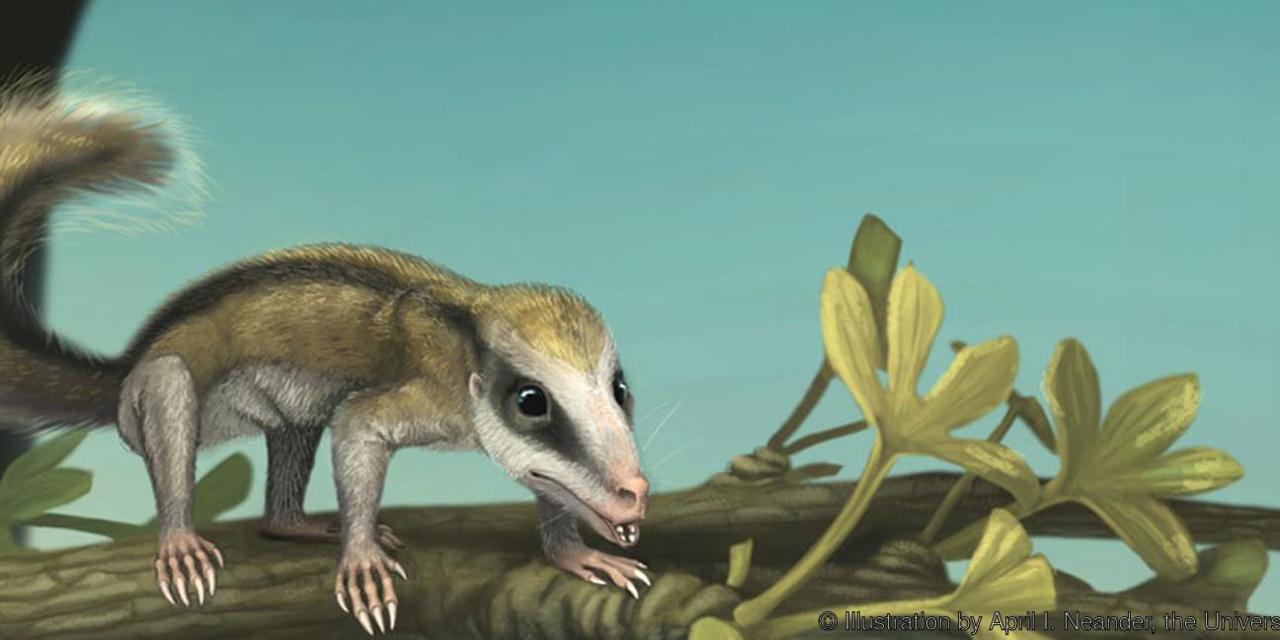
Agilocodon, a chipmunk-like critter that lived 174 to 163 mya.
http://novataxa.blogspot.ca/2015/02/agilodocodon-docofossor.html?spref=fb
However, these early true mammals are the highly mutated descendants of the
weird, dominant synapsid "monsters" of the Permian. The Permian
extinction, in effect, put an end to the "first age of mammals" allowing
the ancestors of the dinosaurs - and the dinos themselves - to get the
upper hand for a hundred million years or so. It is only when the dinos themselves were eliminated by the Late Cretaceous extinction, 65 mya, that the mammalian tribe was given a second chance as dominant terrestrial vertebrates. Mass extinctions tear up and rewrite the evolutionary Rule Book..
So what caused the Great Extinction then? The continents of the time, through plate tectonic drift, had coalesced into a single megacontinent, Pangaea ("all Earth"). This was a disaster, a perfect storm waiting to happen. The worst part was the blockage of tectonic plate movement around the perimeter of Pangaea. The mounting pressure in the Earth's crust and mantle eventually provoked a massive outpouring of magma (lava originating from deep within the Earth) in what is now Siberia. Vulcanism was so intense that it was not confined to individual volcanic cones. Large fissures opened and poured forth molten rock and huge quantities of GHG such as CO2 and methane. GHG warmed the earth, expanding the Great Central Desert of Pangaea. Species died off faster than the background extinction rate marking an extinction event in progress. In the sea, for a variety of reasons, large regions stratified, reducing circulation of oxygen and nutrient minerals. These anoxic (low or no oxygen) strata became dead zones, devoid of life and sometimes laden with poisonous hydrogen sulfide gas. During sudden massive turnovers of stratified oceanic layers, hydrogen sulfide gas was released to the atmosphere, poisoning life along seacoasts. Sometimes the extinction zones could reach hundreds of miles inland as hydrogen sulfide was carried inland on prevailing coastal winds.

And then things got really bad. Life is persistent and resilient, it adapts to and opportunistically exploits changing environments. As Late Permian climates deteriorated new species emerged to replace those eliminated. Some paleontologists even speak of a short-lived mid-extinction recovery phase. But then the Earth's climate systems were driven through a climatic tipping point by particularly strong Late Permian Siberian eruptions. Massive GHG induced global warming delivered the knockout punch. The warming polar regions and their contiguous coastal waters thawed. This had two effects:
1- thawed permafrost containing buried organic matter provided food for microbes and fungi which broke down the organic matter, releasing industrial quantities of GHG: CO2 and methane.
2- methane ice (methane clathrate) - ice containing imprisoned methane - in polar soils and offshore seafloor melted, releasing industrial quantities of methane, a potent GHG.
This, second pulse of GHG release was the sucker punch that nearly killed off life. About 90% of non-microbial species on land and sea went extinct. Evolution's trajectory was permanently modified by the shake up the Late Permian extinction.
"During the Carboniferous and Permian, the diapsids had been a minor element of most faunas, only a small lizard-like creature here and there, never large, and rarely more than 2 or 3% of the total number of animals. In the Early Triassic [period following the Permian extinction], some diapsids, in particular the group called the archosaurs ("ruling reptile") took over the carnivore niches. They preyed on the re-evolving synapsid [mammal ancestor] plant-eaters. During the first 20 million years of the Triassic, the basal archosaurs diversified slowly, and eventually included huge predators, some of them up to 5 meters long. The first dinosaurs appeared about this time, and diversified in the Late Triassic, rather small, bipedal forms at first, they soon reached huge size. Mammals were around during the entire age of dinosaurs, small descendents of the formerly dominant synapsids, but the dinosaurs ruled the Earth for the next 165 million years, until their extinction 66 million years ago. Then, and after a long wait in the wings, the synapsid descendants, the mammals, finally moved back to dominate the Earth, a position they had last had in the Late Permian. The synapsid - diapsid - synapsid cycle [of dominance] had gone full cycle." Page 24
Ok, GHG can be dangerous but what is the relevance for today? The recent explosion of knowledge about the mechanisms of mass extinction is important for understanding the gravity and possible outcome of the current ecological / demographic crises the World is living through. At present, human agricultural and industrial activity has reached a level where it is perturbing the rhythm of the natural recycling of biologically active elements. This situation inadvertently replicates the chemical imbalances of previous mass extinction events, the Great Permian Mass Extinction in particular.
http://transparencycanada.blogspot.ca/2015/10/book-review-vaclav-smil-cycles-of-life.html
A little reflection will show why such perturbations are important. The fact that an element like oxygen, nitrogen, sulfur, carbon, phosphorous, iron is biologically active means two things:
1- abnormal amounts (too little, too much) are liable to interfere with the healthy - normal - functioning of biological systems (organisms, ecosystems). Like powerful machinery or chemicals, what is useful becomes dangerous when misused. Nitrogen, sulfur and phosphorous are extremely active biologically and when present in the wrong amounts or in the wrong form are among the most toxic elements known.
2- "tiny" but chronic imbalances in the rates of element recycling rates soon lead to critical imbalances. Critics of GW (hypocritically or stupidly) argue that the amount of imbalance in Earth's carbon cycle induced by human industrial activity and agriculture is tiny in comparison to the total amount of carbon cycling in Earth's ecosystems. By way of comparison, consider a "tiny" imbalance in the the birth / death ratio of human population leading to a 1% per annum increase in world population. One percent, so what? But this "tiny" increase, year in and year out, leads to a doubling of world population in a mere 70 years, less than a century and just under three generations! The lesson to take away: small cumulative increases (or decreases) lead to surprising results in short order. Even at a much more leisurely growth rate of 1% per decade, human population would take 183 years to double, a mere five generations, a period of time that would only take us back to the invention and early expansion of rail travel and electrical telecommunication (telegraph), a period that we recognize as the beginning of the contemporary technical, industrial society, not so long ago..
We now understand the role that such "tiny" chronic imbalances - produced by natural causes, not human activity - play in mass extinctions of the past. This knowledge places humanity at a cross-roads. Do we, collectively, make the choice to replace GHG producing technologies in industry, power production, transport and agriculture by renewable "green" energy technologies: solar, wind, tidal and wave power, passive solar building heating, hydrogen fuel cells, geothermal energy, energy efficiency and low energy consumption lifestyles? Or do we maintain the status quo fossil energy system till it either disrupts climate to the point that civilized society collapses or we run out of cheap fossil fuel? The choice is ours, today, especially the young people, to make. My generation, the Baby Boomers - those born between 1946 and 1963 - blew our chance at greatness. We, collectively, let ourselves be conned into a hyperconsumptive lifestyle designed (consciously or not) to maximize the profits of multinational corporations. Even those who did not aspire to become the high living "officers" of the multinationals or the financial sector which bankrolls them, applied ourselves to becoming members of the servitor classes (professionals, middle management, technical support). We learned to define our self-worth relative to those we could look down upon because they could not consume as much as we could. In the meantime, we learned to reject the Real Values of life: family, community, pride in work well done, the expression in our personal lives and work of our deepest held values. The millennials (born 1982 to 2000), though they know it not yet, though they feign ignorance or cower in cheap cynicism, will be forced to make the necessary changes my generation failed to make. Do the millennials still have the time and the resources to make the transition to a Green Economy? It's anyone's guess. There may still be enough time and readily extractable resources left but the transition will no longer be peaceful. We Boomers held back change too long.

Methane blow hole in Siberia caused by thawed permafrost. Permafrost locks up buried organic manner for millennia (or longer). When it thaws, the formerly frozen organics become food for bacteria and fungi. The result of their digestion are GHG like CO2 and methane. When gas pressure builds up it creates these huge blow holes in the Siberian tundra. For size comparison note the tiny human figures along the upper rim. The GHG released by thawing permafrost and seabed methane-ice deposits constitute a positive feedback, amplifying the original rise in temperature that released the GHG. This mechanism was the "second pulse" of GHG that constituted the "sucker punch" that killed off 90% of life on Earth during the Permian Mass Extinction.
notes:
1- Isotope: "any of two or more forms of a chemical element, having the same number of protons in the nucleus, or the same atomic number, but having different numbers of neutrons in the nucleus, or different atomic weights. There are 275 isotopes of the 81 stable elements, in addition to over 800 radioactive isotopes, and every element has known isotopic forms. Isotopes of a single element possess almost identical properties."
From dictionary.com.
Thus carbon 12 has 6 protons and 6 neutrons in its nucleus, carbon 13 has 6 p and 7 n. Both are non-radioactive (stable isotopes) with virtually identical chemical properties (only their rate of reaction in biological chemistry may vary slightly). Carbon 14 has 6 p and 8 n but is radioactive (non-stable isotope). In 5,730 years, one half of the atoms in a sample of carbon 14 will have decayed to nitrogen 14 (with seven protons and seven neutrons in its nucleus). Thus the "half-life" of C 14 is 5,730 years. If one can determine the amount of C 14 which remains in an organic specimen (mummy wrapping from a Pharaoh's tomb, for example), one can determine the date of the specimen. A bone which has only one quarter of its original C 14 can be dated to 2 X 5,730 or approximately 11,500 years before the present. (One half of the C 14 remains after one half-life. The second half-life reduces the amount remaining by half - 1/2 X 1/2 = 1/4.)
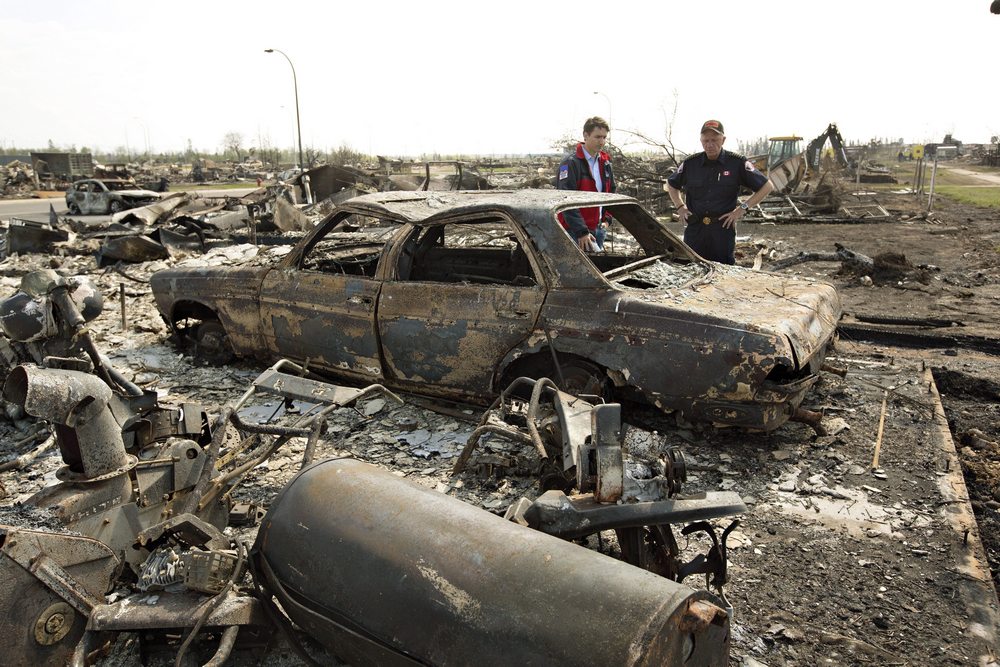
Fort McMurray, Alberta, summer 2016, a monster forest fire - nicknamed The Beast - consumed some 500,000 hectares of boreal forest, an area larger than the province of Prince Edward.
"The fire destroyed 2,400 structures, nearly 10 per cent of the city,
when it ripped through in May and forced more than 80,000 residents to
flee."
http://www.theglobeandmail.com/news/alberta/the-fort-mcmurray-disaster-read-the-latest-weekend/article29930041/
Links to our articles on the Big Fire:
http://transparencycanada.blogspot.ca/2016/05/future-climate-alberta-jumps-gun.html
http://transparencycanada.blogspot.ca/2016/05/alberta-forest-fire-update-monster-is.html
http://transparencycanada.blogspot.ca/2016/05/alberta-forest-fire-update-monster-is.html
A year, nearly, has passed since The Beast passed through Alberta, enough time to begin to register some of its long term effects. Since calamitous fires like the Beast will become more common in a greenhouse gas warmed world, we can begin, if not to measure, at least to appreciate what some of the costs of continued fossil fuel use will be.
externalized cost: Fundamentally, cost externalization occurs when a company transfers some
of its moral responsibilities as costs to the community directly or as
degradation to the environment. For example, railroads and airlines
transfer the cost of fuel, noise, and terminal infrastructure to the
community. Airlines and auto manufacturers transfer the cost of degraded
air quality to the community and the environment. By externalizing to
the community or the environment, many true costs become lost in
analysis because the true cost is non-quantifiable and neither the
community nor the environment have effective advocates to recoup the
damages. A major modern theme in the relationship of business to society
is the society's ability (or inability) to resist this kind of externalization. In its extreme, society collapses as business realizes
its profits. (Wikipedia: cost externalizing)
In effect, the long term human and environmental costs of present and future Fort McMurray-type fires are the externalized costs of employing fossil fuels to power our industrial lifestyles. The continually rising costs of these "negative externalities" pose vital questions to industrial society:
1- are the benefits of our modern lifestyles worth the cost?
2- are their other ways - renewable energy, for example - to obtain the benefits of modernity while avoiding the rising externalized costs whose impacts we are finally beginning to appreciate?
What then will some of the future costs of continued fossil fuel use be? What can we expect?
For openers, the brave, self-sacrificing men who physically and emotionally over-extended themselves fighting The Beast are (probably) damaged for life:
"The University of Alberta study found one in five of the 355
firefighters surveyed reported persistent respiratory issues including
coughing, breathlessness, wheezing and chest tightness. And they're battling more than just physical ailments — mental-health issues affect 1 in 6."
http://www.cbc.ca/news/canada/edmonton/fort-mcmurray-wildfire-firefighter-study-1.4073284
While it is still too early to tell what the long term impacts of the Fort McMurray fire will be, the earlier Slave Lake fire of 2011 may offer some insights:
"Coutts said the Slave Lake fire hit his department hard — half the
firefighters quit within the subsequent two years, and many reported
ongoing respiratory issues."
Imagine! Fifty percent felt obliged to quit their profession because of psychological and / or physical aftereffects. These are the kind of human - and social - costs we should expect on our greenhouse gas warmed future earth. Think of all the money invested in training those fire fighters and all their experience lost. Then there are long term public health costs, to be borne primarily by the taxpayer (not the fossil fuel corporations or their "officers"). Consider also the human costs of post-traumatic stress disorder and broken health: self-medication, drug and alcohol abuse, broken families.. A vast out-rippling of hidden costs and suffering resulting from our collective addiction to fossil fuels. Are the benefits really worth the costs? (Especially as these costs will escalate dramatically in the coming decades..)
'At the end of the day, you're basically trading a piece of your life away to help people.'
http://www.cbc.ca/news/canada/edmonton/fort-mcmurray-wildfire-firefighter-study-1.4073284
At least researchers on post-traumatic stress disorder are making some money from the fire (but the taxpayers still foot the bill..)
http://www.cbc.ca/news/canada/edmonton/one-million-dollars-ptsd-fort-mcmurray-wildfire-1.4073187
"I'm not a professor, I'm just someone learning to deal with mental illness" - climate changed induced mental illness.. (see video link in above article)