An investigation of the theme of Transparency in the Canadian Federal Government. Non-partisan: Power corrupts and Absolute Power corrupts absolutely. Our model: the muckracker journalists.
The short answer: search for indicators of 1- adequate energy flows
2-
chemical cycling: auto-regenerating reactive cycles employing an
external energy source (solar energy, chemical energy stored in mineral
reserves..). Special attention should be payed to strong chemical
disequilibria of chemical species susceptible of incorporation in
biological processes (O2, N2, CH4..)
3- presence of a suitable solvent for biochemical reactions in sufficient quantities
4- polymeric chemistry capable of storing and transmitting information necessary for the maintenance and propagation of life.
"Astrobiology studies the origin, evolution, distribution, and the fate
of life throughout the universe." Thus begins this fascinating trek
into a nascent Space Age science, the logical twin of Astrophysics.
What, then, is life, the subject mattter of Astrobiology's study?
Students of Self-Organization Theory will feel themselves at home with
the authors' definition. One can even conclude that Astrobiology itself
is a projective application of Self-Organization..
- Life consists of bounded
microenvironments in thermodynamic disequilibrium with their
surrounding. Energy and selected chemical species constantly flow across
the boundaries of the organism. The living, metabolizing cell is
characterized by a high internal energy content (stored chemical energy:
sugar, starch, fat, oil..) and low internal entropy (high degree of
functional organization usually structured hierarchally into several
levels)
- Life
transforms energy and matter obtained from the environment to maintain
low internal entropy (highly structured interior). The cell's /
organism's boundary is "porous" and "selective". Energy flows
continually through the metabolizing cell, energy used to regenerate the
cell / organism: "autopoiesis" (self-production). Creationists aside,
autopoiesis does NOT violate the 2nd (or any other) law of
thermodynamics. Autopoiesis represents the physical work extracted from
the energy flow passing through the cell's / organism's boundary. The
internal order - low entropy - of the living cell is, in fact,
overcompensated by the amount of degraded energy - high entropy -
leaving the cell. The cell's activity thus produces a net increase itn
the universe's entropy, satisfying the 2nd law of thermodynamics :-D
(Sorry, "intelligent" designers..)
-
Life encodes and transmits information. Info is transmitted through
genetic codes (DNA), allowing the organized complexity of species to
perpetuate across generations, despite the mortality of individual
organisms. Useful changes in the genetic code - mutations, epigenetic
modifications - must be incorporated into the transmitted code to
provide evolutionary adaptations over time. At the individual level,
novel experiences are encoded in modifications of nervous systems (or
molecular cycles and DNA changes in microbes). Learning, from microbe to
mammal, allows for adaptive behavioral change of both individual and
societies of individuals.
I consider this book a rare chance for the layman to grasp the
principles and a good part of the details of an emergent science before
it becomes complicated, arcane and specialized into proliferating
subdisciplines. In this sense, it is comparable to Darwin's Origin of Species, a highly readable scientific classic accessible to the nonspecialist reader.
What would life elsewhere look like? Most of the biomass on earth - a
planet conducive to the emergence of complex, multicellular life - is,
in fact, microbial. Even large organisms, like humans, can be viewed as
symbiotic colonies of (microbe-derived) cells which, in turn,
incorporate symbiotic microbial colonies: the intestinal bacteria we
"use" to digest our food and synthesize essential vitamins. Physical and
informational constraints favor small size even on our planet so
favored for the evolution of macro-organisms. one can only conclude that
most life in the universe will be microbial in nature.
Life should not be a rare phenomenon: hundreds of exoplanets orbiting
other stars are now catalogued. If earth is taken as a standard, life
evolves early whenever the physio-chemical and energetic conditions for
its emergence arise. Life is, above all, opportunistic. We would expect
to find harbors of life peppered fairly densely throughout the hundred
odd billion stars of our home galaxy - not to mention the hundreds of
billions of other galaxies.
Nevertheless, once established, life tends toward conservatism: if it
ain't broke don't fix it. If environments remain stable, stabilizing
selection will actually narrow the range of phenotypic (and underlying
genetic) variation. Thus the vast body of microbial biomass living below
our feet in the soil and underlying rock has remained simple and
archaic, ancestral forms from which the complex life of the surface
emerged: "organisms will remain static as long as the environment does."
When change - evolution - occurs it is usually as a reponse to
environmental change and is rapid, involving extinction and
replacement, not gradual change. Thus most life elsewhere is probably
structurally and physiologically simple and archaic - as on earth.
However, the emerging (meta-)science of Self-Organization Theory
strongly suggests that the above considerations paint only a partial
picture. Life is opportunistic and will seek (through selective
advantage) to occupy - or even create - new ecological niches through
modification of the physical environment. Thus, large, more complex
organisms - more efficently exploiting specialized ecological niches -
would aslo be expected to evolve over time, physical conditions
permitting. Example: an atmosphere containing oxygen to fuel the high
octane metabolisms required for the mobility of large organisms. Such
"higher" organisms require favorable physical environments , a long time
to evolve, and are higly energivore. We would expect them to be a
relative rarity in the universe. Similar arguments apply to the
emergence of intelligence: intelligent life should exist elsewhere but
as an exception, a rarity.
Finally, taking earth and its biological history as a typical "case
study", we would expect life to appear most easily and evolve most
diversely on worlds presenting a larger variety of environments: deep
seas, shallow coastal waters, wetlands, a variety of emerged lands
(humid, semi-arid, arid, cold, temperate, tropical..) Once again, in
comparing earth with other planetary bodies and moons in our solar
system, earth appears to belong to a class of planets especially favored
for the emergence and flourishing of life.
One of the essential requirements for life is the presence of
"adequate" energy fluxes. In a sense, energy is the essence of life. A
continuous regulated energy flow through the boundaries of an organism
maintains life. Without this flow the organism either dies or creates
inert - non-metabolizing - copies of its genetic code, for example.
spores. Spores remain inert until conditions propice for life reappear
at which time they reconstitute the parent organism of which they are
clones. Energy flow, in the modern materialistic view of life is the
analog of the "vital force" and "soul" of primitive and pre-scientific
Western thought.
The energy flow transversing the boundaries of an organism is used to
perform the work of self-reparation and maintenance as well as perform
physiochemical work: muscular effort; registering, encoding and storing
information derived from the environment and internal body states
(neurological activity); production of eggs, embryos or other
biomaterials (silk, spiderweb, toxins..)
On earth, there are two primary energy sources exploited by life: 1-
photosynthesis by plants and bacteria and 2- redox chemical reactions
(liberating energy stored in inorganic mineral substrates
(chemoautotrophy). The chemoautotrophic bacteria, Thiobacillus
ferooxidans, extracts energy from minerals by oxydizing sulfur or iron.
On earth heterotrophic organisms (incapable of extracting their energy
directly from the environment) such as herbivores and carnivores exploit
secondary energy sources found in the energy rich molecules synthesized
by primary producers such as plants. The rich, diversified ecosystems
of energy rich earth typically have several "trophic" levels in the food
chain (or web): autotrophic ("self-feeding") primary producers like
plants that capture energy from sunlight and store it in energy rich
biomolecules (sugars, starches, oils, fats..), heterotrophic ("feeding
off others") herbivores which obtain their energy inputs by eating
plants, primary carnivores which obtain energy concentrated in the
tissues of herbivores. Follow secondary and tertiary carnivores,
omnivores (which obtain energy from several distincts sources: plants,
herbivores, even lower trophic level carnivores, detritus..), and,
finally, detrivores which extract residual energy found in dead /
decomposing organic matter. Detrivores form an essential link in the
food web by "re-mineralizing" dead organic matter into a form utilizable
by photosynthetic plants. Nature, is above all, the Great Recycler -
nothing is wasted!
On earth sunlight and chemical energy are equivalent in terms of their
relative energy yield (energy density). Both are widely employed, to the
excusion of other potential energy sources (thermal energy, kinetic
energy of currents of water or air, the earth's magnetic field..)
However, the potential biological use of other forms of energy is shown
by the fact that terrestrial organisms use the earth's gravitational and
magnetic fields as well as biogenetic electric fields to obtain
information about their environment: orientation with respect to the
gravitational field, navigation of birds and eels, location of prey by
electric field detection.. It is arguable that on earth these
alternative energy sources were simply outcompeted by the abundance of
light and chemical energy and were relegated to sensory functions. On
other worlds - Jupiter's "water world" moon, Europa, for example - light
is absent as an energy source and other forms of energy may be used to
power metabolic processes. (If life exists on Europa, it will most
likely be found in a global ocean, beneath a planetary ice shield dozens
of kilometers thick - no light could penetrate such a thickness of
ice.)
Several potential energy sources are explored and found capable of
providing biologically useful amounts of energy. # 1 - 4 in the
following list look particularly promising even for energy hungry
multicellular life. # 5 - 6 may still provide usable energy densities
for microorganisms:
1-
thermal energy (example: volcanic or other internal heat sources which
maintain Europa's ocean above the freezing point despite its great
distance from the sun)
2- kinetic energy of currents of air or water
3-
osmotic gradients (differences in solute concentations across a
biological membrane. The energy flux transversing the organism is used
"pump" solute molecules inside / outside of the membrane thus storing
energy - for later metabolic use - in the osmotic gradient)
4-
ionic gradients (differences in ionic species concentration across a
biological membrane such as salinity gradients. Same principle as omotic
energy storage. On earth ionic gradients across cell walls are use to
power nerve impulses and muscle contraction. The energy stored in the
ionic gradient was originally obtained from the chemical energy
contained in food.)
5-
radiation (example: dissociation of water in the ice shield of Europa by
magnetically induced radiative flux. The energy in the radiative flux -
charged particles accelerated by Jupiter's intense revolving magnetic
field - is transfered to liberated atoms of hydrogen and oxygen which
would then be employed by microorganisms living in water inclusions in
the shield ice. Alternatively, some oxygen could diffuse through the ice
shield for use by primitive organisms living on the underside of the
ice shield, "ice roof dwellers")
6-
magnetic field (Jupiter's magnetic field is 12 times as strong as
earth's and therefore could be directly employed as an energy source by
European organisms with the energy stored, for example, in energy rich
biomolecules.)
7- gravitational field
8- pressure gradients
9- tectonic forces
The last three potential energy sources are less promising from an
energetic viewpoint but cannot be totally excluded in extreme
environmental conditions. Example: large planet with intense
gravitational field or pressure gradients.
One conclusion seems fairly well established by modern biology. Life as
we understand it requires a liquid phase to exist: liquids provide the
required density and mobility of bioreactant molecules. The authors
examine alternative solvents for biochemistry. For a variety of reasons
water appears to be the most suitable solvent: large thermal band in
which it remains liquid, high heat of vaporization, proper degree of
reactivity with carbon compounds, electrical polarity of the water
molecule, etc. Once again, Earth - the "blue planet" because of its
oceans - appears to be a cosmic niche particularly suited for life to
evolve and to evolve to high levels of complexity and organization.
At
lower temperatures - upper cyrogenic range - a saturated ammonia /
water solution might serve as a biological solvent. Saturated NH3 / H20
geysers - indicating, perhaps, subsurface oceans - have been detected on
several of the large moons of the outer solar system (Io, Triton..)
Several of these bodies seem to possses adequate energy fluxes,
essential for life to emerge. Potential sources of these energy fluxes
are gravitational flexing, radioactive metallic planetary cores and
induced electric currents in liquid iron cores exposed to Jupiter's
intense magnetic field. In addition, several of these bodies exhibit
self-regenerating chemical cycles driven by energy fluxes (Titan, Io,
Europa, Triton, some levels of Venus' atmosphere..). Such cycles are
considered to be the precursors of life. It should be empasized though
that the mere presence of such chemical cycyling does not, in itself,
indicate the presence of life, merely the POSSIBILITY of life. Titan - a
moon of Saturn - shows signs of polymeric chemistry. Thus Titan meets
the four requirements of life stated at the beginning of this review:
1- adequate energy flux, 2- chemical cycling, 3- suitable solvents
(liquid methane and ethane are possibly suitable biosolvents at low -
cyrogenic - temperatures) and 4- polymeric chemistry. Whether any body
in our solar system other than earth possesses life is debatable but at
least we know what to look for and we are already registering several
potential candidates. Microbes and photosynthetic algae may florish on
Mars. Europa may harbor marine life the size of shrimp or small fish
beneath its ice shield. Because of low temperatures life, if it existed
on places like Io, Titan or Triton would be "exotic", probably microbial
life existing in saturated ammonia water solution, liquid methane /
ethane, or liquid nitrogen. Such life, at this stage of our knowlege,
is, of course, highly speculative. Mars and Europa are our best bets for
"life as we know it".
Interestingly, the authors throw out the popular notion of a "habitable
zone" around stars. The idea might still prove useful in the search for
earthlike habitats though. It is now recognized that the conventional
habitable zone hypothesis is too restrictive, especially for hardy
microbial life. Contemporary knowledge of planet formation indicates
that planets (or large mooons) pass through an early accretion phase
(through gravitational attraction). The infalling matter heats the
forming body (kinetic energy). Since water is abundant, one would expect
many bodies to pass a part of their existence with a water covered
surface. Depending upon the size, chemical composition and distance from
the star, millions to billions of years might pass before all the water
was frozen. This might give life a chance to evolve, even if the body
does not lie within the conventional "habitable zone". We might
therefore find fossil microbial - perhaps macroscopic - life forms on
Mars and some of the large moons of the outer solar system.
Alternatively, on some cooling worlds microbial life (in particular)
might be able to pull off the transiton from say, a saturated NH3 / H2O
solution to another, low temperature, solvent like liquid ammonia,
methane or nitrogen. Don't be TOO surprised if frigid Triton (a moon of
Uranus covered with nitrogen snow) harbors microbes breeding in
underground liquid nitrogen oceans using a free radical based chemistry
(those nasty free radicals which our bodies spend so much effort
destroying and which we attempt to destroy by popping anti-oxidant
pills). At low temperatures, the chemical reactions our bodies use are
too sluggish to fuel life. Free radical chemistry would fit the bill
although at the temperatures our biology operates at free radical
chemistry is "too hot to handle" and free radicals damage the integrity
of infomation carrying biomolecules causing cellular aging and
pre-cancerous genetic damage.
The authors conclude with a list of "biosignatures" and "geoindicators"
- chemical species and landform modifications - which a satellite based
remote life detection program might employ. The number of "hits" in our
solar system is quite surprising.
This is a technical monograph - published by Springer Verlag - intended
for a scientifically literate audience. Technical terms are generally
not defined and there is no glossary. A few graphics lack clarity. On
the whole, tight, very compact, generally well written. Excellent reading.
Andrew H Knoll: Life on a Young Planet, Princeton University Press (2003, 2015), 246 pages, index, numerous photos and diagrams, very extensive "further reading" list for those who want to pursue the origin of life and early evolutionary development.
We shall not cease from exploration And the end of all our exploring Will be to arrive where we started And know the place for the first time T S Eliot
Despite an almost bewildering diversity of form and function, all cells share a common core of molecular features.. The reciprocal observation is equally striking. In spite of their fundamental unity of molecular structure, organisms display extraordinary variation in size, shape, physiology, and behavior. Life's unity and diversity are both remarkable in their own ways; together they comprise the two great themes of comparative biology. (page 17, emphasis added)
Animals may be evolution's icing, but bacteria are the cake (page 19)
abbreviations used in this article:
CO2: carbon dioxide, involved in the photosynthesis / respiration cycle. It is also a greenhouse gas, trapping heat (infrared radiation) and warming the earth.
Mya: million years ago
geological periods discussed:
Cambrian: 543 Mya to 485 Mya. During the "Cambrian Explosion", "large" - multicellular - plants and animals appeared. "Modern" - oxygen breathing- forms of life proliferated in the seas and soon spread to land in the following order: plants, arthropods (insects and their kin) and, finally, our own ancestors, the vertebrates (marine tetrapods)
Proterozoic (also called the pre-Cambrian): about 2.5 billion to 543 million years ago. Aside from colonial microbial stromatolites which formed coral-like structures in water, life was microbial. See two stromatolite photos below.
Most definitely a nerd book. The intended readership are both science literate general readers and workers in the earth and life sciences. To appreciate this text fully you need a decent background - self-acquired or school learned - in the earth sciences, paleontology and evolutionary theory in particular. A basic grounding or working knowledge in biology (ecology) and (bio)chemistry helps. On the plus side, the author's style is remarkably readable. Essentials are generally well explained, allowing the novice to tread into deeper waters than they otherwise would be capable of handling.
The subject of Life on a Young Planet is the appearance and evolution of early life on earth before the Great Cambrian Explosion, about 600 million years ago (Mya), when "large" (visible to the naked eye) plants and animals wildly proliferated and "the world as we know it" was born. On young earth, life was microscopic: bacteria, one celled animals and plants.
How old is life? The first microfossil traces of life are hotly contested. Mineralogical processes can produce microfossil like structures. Finding "biomarkers", chemical signatures of life (or of its decomposition products), in association with putative microfossils can, in some circumstances, provide a strong case that one is dealing with real microfossils. Today, claims of microfossils 3.7 years old are being made. If confirmed, they would indicate an extraordinary early emergence of life. The solar system was born 4.5 billion years ago and the earth itself is only about 4 billion years old!
The modern tree
of life, based on genetic similarity. Modern multicellular animals and plants are found in
the upper right hand corner among the "more evolved" Eukaryota. Click on image to enlarge.
Everything you wanted to know about Archaea - the extremophiles - but were afraid to ask:
A modern
testate amoeba, which lives in a mineral shell which is secreted by this one
celled "animal" (technically, a protist, neither animal or plant). Testate amoebas are Eukaryota, "more evolved" lifeforms, and lie on the rightmost branch of the Tree of Life along with animals and plants. See above diagram. They are one of earliest animal-like life forms dating back at least 750 Mya, well before the Cambrian Explosion when modern multicelled animals and plants proliferated, diversified and flourished. Testate amoeba are still important members of contemporary aquatic and soil ecosystems!
A fossil testate amoeba shell unearthed by author Knoll. The white bar on the lower left of the photo is 25 microns (millionths of a meter). The shell is thus about 100 microns in length, the width of the average human hair. It was secreted about 720 to 635 Mya in the pre-Cambrian.
Video of living testate amoeba. The shell is composed of sand grains cemented together with silicic acid secreted by the amoeba.
Over time early microbes developed communal "biofilms". Later, biofilms would evolve into the tissues of higher multicellular organisms like plants and animals). Stromatolites are pseudo-corals consisting of layers of mineral matter (sand grains or fine sediments) alternating with photosynthesizing microbial mats. Stromatolites may achieve impressive dimensions and some stomatolite fossils have been dated at a credible 3.5 billion years. Interestingly, living stromatolites are found in some seas today.
living stromatolites, Shark Bay, Australia
pre-Cambrian stromatolite fossil from Bolivia
Life on a Young Planetargues that life is a co-dependent, co-evolving network of energy flows, chemical cycles and living organisms, a living tissue or fabric which includes the body of the earth itself, its seas and atmosphere. The health of individual organisms and species ultimately depends upon the integrity of the whole fabric, a lesson humanity is painfully learning today because of our disruption of vital ecological systems and the chemical equilibria of the planet.
An interesting example of co-dependence and co-evolution are the Eukaryota, the domain which includes dominant modern life-forms like plants and animals. It is now believed that the Eukaryota arose from the symbiotic co-dependence of single celled organisms. It is believed that the mitochondria - the sub-cellular "organelles" which our bodies' cells use to burn sugars with oxygen to liberate vital energy - were once free living organisms. Several lines of evidence support this conclusion, including the fact that mitochondria contain their own DNA (genetic code) and replicate independently when our bodily cells replicate.
From the micro-level to the macro-level, the co-dependence and co-evolution of life is evident. Plants absorb carbon dioxide (CO2) from the air and water from the soil. Using the energy of visible light rays from the sun, sugars, starches and other energy rich molecules are synthesized from CO2 and water during photosynthesis. Oxygen is released as a by-product. Photosynthesized energy rich hydrocarbons (sugar, starch, oil, fat) form the basis of the food web. Herbivores eat plants to incorporate energy rich hydrocarbons to power their metabolisms. Carnivores eat herbivores to incorporate energy rich molecules incorporated in the herbivores bodies. Through co-dependent co-evolution, efficient carbon cycling was established over time: the photosynthesis / respiration cycle. Plants absorb CO2, synthesize energy rich hydrocarbons and release oxygen during photosynthesis. Animals respire the oxygen released by plants to burn energy rich hydrocarbons, releasing CO2 in the process. A rough equilibrium between photosynthesis and respiration has been established over time allowing all organisms to flourish. Too much oxygen, and our forests would burn up in planetary conflagrations while too little would prevent the emergence of animal life.
But co-dependent co-evolution runs even deeper. Both plants and animals are Eukaryota. When these organisms die most of their organic matter is quickly recycled by decomposers: insects, worms, fungi, bacteria.. But not all organic matter is recycled. In water, organic matter may precipitate to the bottom as sediment before it decomposes. Such environments are often anoxic, contain little or no oxygen. Now, Eukaryota like plants and animals require oxygen and are therefore incapable of extracting energy from buried sediments (and, in the process, recycling vital bio-elements back into the environment, in this case, sea or lake water). Only anaerobic prokaryota - micro-organisms not requiring oxygen for metabolism - are capable of processing buried organic matter to liberate essential bio-elements like nitrogen and sulfur. In effect, without the recycling activity of the "lowly" prokaryota, we "more evolved" Eukaryota would disappear as vital bio-elements were buried and removed from biospheric circulation! The "web of life" is much more than a fuzzy New Age or mystical meme. It is a literal, physical reality upon which our very lives depend..
As prof Knoll puts it so eloquently,
"Life on a Young Planet records that moment in time when biologists and Earth scientists began working together to build an integrative picture of our planet's history. We now know that we can only understand life's evolutionary trajectory by embedding it in the chronicle of Earth's dynamic environmental history. That is the lesson of deep Earth history, and it is also a lesson for today, when human technology has emerged as an environmental force of geological prominence. Whether we look outward, searching for a second example of life, or forward, hoping to navigate wisely through an era of mounting global change, the record of Earth and life through time provides a fundamentally important catalog of experience that can help guide our actions." (page XV, emphasis added)
As is so often the case with the best science writing, much of the charm of this book comes from it's evolutionary approach to science itself. The clash of competing theories, the fruitful alliances between disciplines, the slow unearthing of critical clues.. all these are grain for Prof Knoll's mill. For those interested in life's early history and deep ecology and who possess the requisite science background, this book is a must read. Even novice earth science readers should find it a challenging and stimulating read (and don't forget the extensive suggested reading list for aid..) Definitely recommended.
"For scientists, unanswered questions are like Everests unclimbed, an irresistible lure for restless minds" (page 224)
Sébastien Steyer: Earth before the dinosaurs, Indiana University Press, 2012, 173 pages; profusely illustrated: photos, paintings, sketches; bibliography, index.
The magnificent artwork and sketches are by Alain Bénéteau
abbreviation used in this article:
- mya: million years ago (before the present)
I originally decided not to review this exasperating - and wonderful - book: too small a potential audience, too specialized, too technical, some serious pedagogical issues..
However, perhaps against better judgement, here 'tis. Ultimately I was moved to write because I love the book and hope that a few readers will decide to check it out at their local library and enjoy it as thoroughly as I did. (If your library doesn't have it, recommend it to the holdings department. Most libraries welcome suggestions. I suggest several books per year and have been refused only twice. This way you get to read a good book for free and assure that others will have the chance to read it too.)
Subject: Early tetrapod (four-legged animal) evolution from the Devonian to the Permian mass extinction, 416 - 250 million years ago (mya). This is our history, human history, in deep time since humans are mammals and mammals are modern representatives of tetrapoda, the four-legged tribe.
The image above is hynerpteton, a Late Devonian tetrapod, 360 mya. Hynerpeton was an aquatic carnivore living in coastal mangroves, capable of limited motility on land (like a modern walrus or seal). Its primary mode of propulsion was the large tadpole tail, visible in juvenile frogs and the embryos of terrestrial vertebrates.
Before the dinos was originally published in French. Chris Spence, an ex-patriate American living in Paris, deserves due credit for the quality of the translation. I had no impression whatsoever that the text had been composed in a language other than English. Good job, Chris! The only gaffe I found was the translation of the Canadian province, Novia Scotia as "New Scotland"! Quite an odd error for a professional translator..
It is rare that science books, especially highly technical ones, are considered "beautiful" (as one reviewer was moved to remark). The quality of the artwork, in fact, moved me to undertake this review. At times it is stunning. The illustrator, Alain Bénétau, prefers dramatic "cloud-wracked" skies, threatening storm. On the whole the images are far more life-like (hence interesting) than one would expect for an academic work.
Eusthenopteron: 385 million years ago, Devonian. A "transitional" fish with some characters of land animals. Note all those fins! Two of the lower pairs developed into tetrapod legs. The above two images are from Before the dinos.
Some of the images achieve a quasi-photographic quality to the point one can imagine one is looking at a photo of an exotic rain forest critter in National Geographic. The image of archaeothyris, 310 mya, the "oldest known synapsid" (the ancient genetic lineage of which mammals are the sole survivors) could fool most people,passing off as a photo of a somewhat scary looking modern reptile, 20 inches in length.
The visualsare the book's strongest point. It is literally jammed full of images of all sorts: paintings, sketches and photos, body silhouettes, several per page. Many are photos / sketches of fossils, including in situ photos before removal and preparation of the fossil for display. Fossil photos are generally accompanied with one or more sketches outlininganatomical features of evolutionary importance. I found these a pleasant way to deepen both my knowledge and appreciation of early vertebrate evolution.
Ichthyostega (top) and acanthostega: early tetrapods. Ichthyostega had a robust shoulder girdle and front limbs which allowed it to hump about on land by alternately scrunching up its tail to push forward and then using its powerful front limbs to push back (the hindlimbs were useful for swimming only: too short and badly angled to walk with. Fossilized races of body dragging as described above are found in places where ichthyostega was abundant. Acanthostega (bottom), also an early tetrapod, was not to any degree adapted for locomotion on land).
The biggest, most glaring flaw of Before the dinos is the absence of a technical glossary: absurd for such a technical and highly specialized text, and particularly for one with pretentions of a larger readership. The quality artwork does, in fact, suggests an attempt to appeal to a larger readership, an impression furthered by the blurb on the front and back covers of the original French edition. In addition, prof Steyer included photos of field working conditions and modern paleontological technology (scanners, radio-isotopes..) both of which would be irrelevant if the intended readership was purely an academic or professional one. He also waxes idylically about the pleasures of a career in paleontology on several occasions: also irrelevant for a professional readership. The lack of an adequate glossary is thus as puzzling as it is irritating. I was eventually reduced to inserting book marks in places where technical terms were defined so I could flip back to refresh my memory when I got bogged down in a particularly dense thicket of technical verbiage: ichthyansarcopterygian versus tetrapodomorph sarcopterygian for example (!!!) C'mon prof Steyer, give the reader a break..
Ichthyostega seizing prey 360 mya in a Devonian coastal mangrove. Note the submerged tree trunk..
History of the tetrapods, the four legged tribe: This history displays the strong dependence of organisms upon their environment and, by inference, the impact of the physical environment on biological evolution. (see footnote 1). Way back in the Paleozoic (early life) earth, the moon was much closer than it is today. This increases the gravitational forces raising tides. In addition, the earth rotated a bit faster, further increasing tidal forces and raising higher tides. The result was that the intertidal zones, the land impacted by daily incursions of tides, were much larger than today's intertidal zones. Marine mangrove ecosystems - intertidal forests - were much, much more extensive and diversified than today.
modern mangrove, where sea and forest meet
Paleozoic mangroves provided a rich, diversified, "fractally broken" network of partially interacting "microclimates", very favorable to evolutionary experimentation and diversification. (note 2) In this perspective the early tetrapods can be seen as highly mutant fish, intermediate in form and function to both fish and land animals. Thus tetrapods, as a group, possessed both lungs and gills. But why lungs?
In the light of current knowledge, lungs did not evolve in some attempt to "conquer the land". It is likely that they were used for dealing with oxygen impoverished water. The large intertidal zones of the Paleozoic, circa 350 - 400 mya, would have been characterized by very high tidal velocities, compared to today's oceans. This is reflected in the large amount of fossilized plant "litter" found in Paleozoic mangrove sites. The litter would have provided nutrients for abundant bacterial blooms, particularly on warmer, subtropical and tropical seacoasts. The bacterial blooms would have de-oxygenated the water, necessitating the evolution of a backup system of respiration: swim bladders modified to serve as lungs. The development of air-breathing was not, therefore, an adaptation to life on land or a "stage" in the "conquest of the land". Lungs and air-breathing were merely an adaptation to an oxygen deprived aquatic environment. Then, since life is opportunistic, only later did some of the critters re-adapt their capacity to breathe air to spend more time on land. The "fractally broken" mangrove, comprised of alternating stretches of shallow swamp and land, could be better exploited by amphibious tetrapods capable of negotiating short stretches of terra firma separating adjacent swamps. They were still aquatic predators: living on the land "for real" would only come aeons later.
Chiridian limbs, you say? The greatest innovation of the tetrapods, when they were still aquatic (be it noted), was probably "chiridian limbs". These are the limbs of land animals (including cetaceans - whales and dolphins - who returned to the sea).The primary feature of interest here is the termination of chiridian limbs in bony digits as opposed to the cartilaginous rays typical of fishes. See graphic below. Typically, the early aquatic tetrapods and tetrapodomorphs ("close-to-tetrapods"), had 6, 7, or 8 digits per limb, probably reflecting their usage in swimming (big webbed foot to displace a lot of water at each stroke).
Ichthyostega and the beginning of chiridian limbs, the word "rayons" in the leftmost limb sketch is French for the cartilaginous rays of fish fins. Panderichthys shows a curious hybrid form found in some early tetrapodomorphs: the bones of the limb are analogous those of land animals (modern tetrapods) while the cartilaginous rays are typical of modern fish!! A "missing link" (sort of).. Click on the image for a larger more readable version.
In reality, no one knows for sure why chiridian limbs evolved in the first place: no one can identify the "selective pressure" driving their evolution. The very earliest chiridian limbs appear on critters whose anatomy did not permit them to crawl about on land. (When critters began spending some time on land, then chiridian limbs, with their robust terminations did indeed prove useful - but they did not evolve for that purpose.) Prof Steyer proposes that they might have been used for seizing and holding the female during mating but admits this is pure speculation.
Another suggestion I have come across: chiridian limbs allowed tetrapod predators to sneak up on their prey, walking along the cluttered bottoms of mangrove swamps, concealed by bacterial bloom clouded water. Their prey, like other fish, would have possessed "lateral lines" with sensory endings designed to detected the vibrations set up by the fins of approaching predators. Sneak-walking along the bottom would have produced less low frequency vibrations than swimming. Another possibility (from myself): some of the early tetrapodomorphs and tetrapods have flattened bodies and eyes on the backs of their heads. This suggests that they concealed themselves on the bottom waiting for prey to come by. If so, they could have used their chiridian limbs as shovels and fans to spread mud and fine sand over themselves for concealment..
Missing links - real or imaginary?Prof Steyer rejects the notion of evolutionary "missing links" because, he believes, evolution has no goal, no final purpose. There is no "plan" directing evolution "from" species A to B to C with B the "missing link" between an earlier, more "primitive" form, A, and the "more evolved" form, C. In reality, Steyer argues, when we speak of missing links we are confounding familial likeness with an ordered (intentional) sequence of steps. Similarity in the fossil recordmerely reflectsgenetic descendance, not the unfolding of an "evolutionary project".
From Steyer's "democratic" interpretation of evolution, each species is its own "goal" in the sense that its members seek to survive an propagate their kind. In this perspective, humans are not really "superior" to other life forms. Rather, each form of life possesses its own specificities, its own "essence" or mode of "being-in-the world". Its specificity allows a species to occupy / create an ecological niche which it will occupy until changing environmental / ecological conditions render it "obsolete" and it will be replaced. Ichthyostega was not a "stage" on the road to becoming-human. It was not even out to "conquer the land". Its chiridian limbs provided some mobility on terra firma, allowing this predator to extend its hunting range. It could cross a stretch of dry land to get to the next wet piece of mangrove swamp. With improved mobility, it prospered until environmental conditions changed or until a competitor better adapted to its environment appeared. The only reason ichthyostega bears features in common with tetrapods, mammals and humans is because it belonged to a successful group of species that left descendants, including ourselves. Ichthyostega was merely doing its thing: predating, fleeing, fighting mating, not "striving" to give birth to humanity, a third of a billion years later..
Comment: In principle, prof Steyer is - most likely - correct in denying an overall purpose or identifiable goal in biological evolution (at least as a first approximation to reality). Nevertheless, this should not blind us to the possibility - the likelihood! - that certain "evolutionary strategies" prove more successful than others. Thus vertebrate evolution has established several lineages (birds and mammals) in which "cephalization" has proven a successful "strategy" over time. The brain becomes larger and more complex despite the enormous drain on metabolic resources (oxygen, energy) required to maintain a large brain. The increased behavioral adaptability a large brain permits can, in some environments, offset the increased metabolic demands of feeding a big brain. Minaturization is possibly another emerging evolutionary trait in vertebrates. As the nervous system evolves, cooperation between increasingly intelligent individuals becomes increasingly advantageous from a survival standpoint: two heads are better than one (especially if both are smart..). In this scenario, cooperating individuals have a lowered mortality, hence greater ability to pass their smart genes on to offspring. Each generation will, infinitesimally, tend to be brighter than the previous.Now, this situation generates "selective pressure" for greater population densities: a denser population permits more cooperative interactions between individuals. Unfortunately, natural ecosystems can only feed so many individual per square hectare. A way around this bottle neck - a new "selective pressure"! - is to reduce the average size of individuals thus allowing a greater population density for the same amount of food consumed. If the competitiveness of the species is improved, selection will lead, over time, to smarter, smaller individuals. Some evolutionists believe there is evidence for such miniaturization of modern, highly cephalized vertebrates.
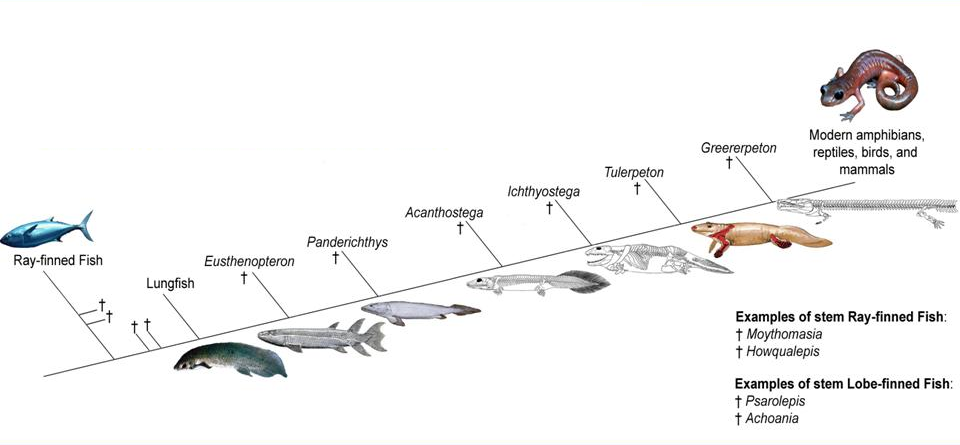
How modern tetrapods, upper right, are related to fish, left. All the critters between lung fish and modern tetrapods - "the missing links" - have gone extinct.. Again, click on the image for a more readable enlargement.
Coelurosauravus and fossil. A glider, not a true flier.
Moradisaurus grandis, late Permian herbivorous reptile Note the large defensive talons - "don't mess with me!"
notes:
1- Climate change as a - or the - major "driver" of bilogical evolution on earth:
internal blog links: keywords: science, book review, climate change
2- The following quote is from a recent book review of a text on Disturbance Ecology which deals with the biological diversity fostered by fragmented, frequently disturbed ecosystems: "Disturbances
help generate the mosaic makeup of the habitat. A fire burns out a
patch of forest and open it up to sunlight. Now, small plants, which had
been suppressed by the shade of the trees, can thrive, and then a
meadow can develop. Every organism is uniquely adapted to a particular
type of habitat and a diverse array of habitats can support many more
species than a uniform habitat. A variety of habitat patches, in turn,
supports a diversity of species and communities. This biodiversity is the foundation of the natural ecosystem services upon which all life depends.
Contrary to common thinking, disturbances are not bad, but rather they
are valuable - indeed, they are essential for healthy ecosystems.. The
nature of nature is change."