Showing posts with label existentialism. Show all posts

Wednesday, June 21, 2017

Fake news and mythology


What is the relationship between fake news and mythology?

Religious myths, conspiracy theories, and new gnosticisms.

                          First a definition, so we all start on the same page. A definition of fake news:


https://en.wikipedia.org/wiki/Fake_news


                          But what about myth? The term has acquired several, sometimes contradictory meanings. In the post-Enlightenment era (19th century and beyond), myth has come to mean a false - "primitive", "superstitious" or "pre-scientific" - description or narrative of the world. Traditionally though, stories that we today call myths - at least the Great Myths of religion - were taken as absolute truths in much the same way that a modern rationalist believes in the statement "two things plus two things gives four things".


               Myths in the traditional - religious - sense were critically  important parts of human psychic architecture. They situated the person in a universe full of sense, meaning and purpose. (In practice, the purposes of some of the hypothesized entities - spirits of the enemies one killed, nature spirits, offended divinities - could be quite malevolent.) The animistic universe of ancient hunter-gatherer peoples was a world full of life, purpose and intent. One placated angry gods, one offered sacrifices to obtain their favor in enterprises. We have forgotten how revolutionary the ancient Greek "philosophers of nature" were. Rather than seek the causes of events in the whims of gods and spirits, they sought to understand the unfolding phenomena and processes of the physical world in terms of material processes (which could be captured in the elegant intellectual forms of mathematics). 
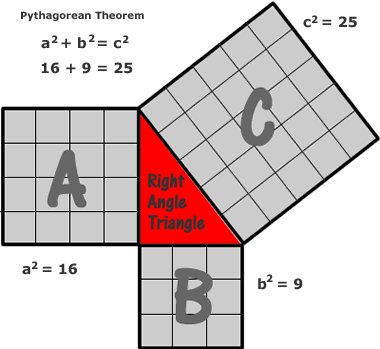
 Pythagorean theorem: in a right triangle the length of longest side squared is equal to the sum of the squares of the lengths of the other two sides. Pythagoras flourished six centuries before Christ.

                One can draw several conclusions from an "evolutionary" perspective. The most obvious is that "Reason" - at least as the dominant mode of thinking - is a relative newcomer on the historical stage. Myth as a form of explanation of the world is vastly older! (In reality, it is an open question if Reason is the dominant mode of thought today.. We seem in some ways to have hit upon the worst of both worlds. We have, collectively, great powers for manipulating the physical world with technology but too often, alas, that manipulation is for idiotic or antihuman ends.)

                  In their highest manifestation, myths are "sacred stories" told to explain the world, why it is like it is, who "we" (the members of our tribe) are and what values we hold. Myths describe the Good Life (particularly the Good Life in a social context). Myths, as narrative, are an outgrowth - an extension and an elaboration - of the "primate politics" of our biological ancestors. They tell who did what to whom, what the outcome was and why that outcome is important to us living today. Myths are "hard-wired" into our human nervous systems: myths and stories are universal, wherever there are humans there is story telling and sacred narrative.

              But why are myths and narrative universal?  One can hazard, with some anthropological and psychological evidence supporting, that it is natural for humans to view the world through the lens of narrative. Because of hard-wired primate political thinking we naturally wonder who did what to whom and why. Our minds are simply hard-wired to think along narrative lines.

             From this perspective, the formal, mathematical abstractions of science are more recent evolutionary acquisitions. As such, "abstract thinking" lacks the compelling force of concrete narrative. Here we see one of the disadvantages that climate scientists and environmental activists have in dealing with the raw, more primitive, emotional narratives of GW "sceptics" and deniers. Quantum mechanical energy exchanges at the molecular levels are hard to grasp (abstract scientific thinking). Our primate political genes though, are programmed to identify and understand the following narrative-type: crooked university professors peddle the "climate change hoax" in order to make trillions of dollars on the carbon credit trading market. In other words, climate scientists are an enemy clique plotting to do "us" in dirty - this is pure primate politics!

A general listing of Authoritarian Personality traits (both leaders and followers)

authoritarian personality traits 

                In general, "classical" authoritarians see the world in black and white terms: "us" versus "them", "Good" versus "Evil". Their perceptions of social groups tends toward stereotypy: all wo/men (blacks, Jews, gays, Muslims..) share a common set of characters. The group one belongs to is more important than one's individuality. In addition, authoritarians demonize the excluded groups they hate: people belonging to out-groups are treated as subhuman, incarnate all evil, plot to enslave the world to their wicked ends.

                I mention the Authoritarian Personality here because it represents a particularly primitive (hence emotionally compelling and "natural") expression of primate politics that is activated in situations of threat and uncertainty. The paranoid narratives of Authoritarians flourish in critical periods of social transition such as the one we are living through today. "Fascistic" paranoid delusional narratives become prevalent - even dominant - myths at times of social breakdown and transformation.

                It is hard to describe how wacky the paranoid delusional worldview can become! To do justice, I can only copy verbatim from a "chemtrails, New World Order conspiracy" website. Hold on t'yer hats, folks, the wind she's goin' t'blow!

"Population "Control," New World Order Style
  
The Illuminati's idea of Population Control falls into two broad categories:
 
1. Limiting the size of human societies and monitoring/controlling the movement of individuals within that society, and

2. Intentionally reducing the bulk of the world's population through GENOCIDE via the introduction of orchestrated conflicts, intentionally inserted toxic substances into the air (chemtrails), environment (depleted uranium), water/food supply (GMOs), and bioengineered, weaponized disease organisms (AIDS, Ebola, Bird & Swine Flu, etc.) along with anti-fertility compounds introduced via vaccines and other means of external transmission.
....
In order to preserve the 'best' of humanity when the supposed 'self-destruction' of the earth takes place around the year 2,000, the JASON Society proposed that a vast network of underground cities be built in order to secure living quarters for the chosen Illuminati elite, high level cooperative politicians, and selected military elements. Underground cities are also co-habitated by extraterrestrial alien groups that the secret government has made treaties with for technology exchange and human-alien hybrid breeding programs. The idea of the earth 'self destructing' around the turn of the century due to overpopulation was perhaps an early cover story for the justification of the underground cities. In the 1950's and 60's, the American public was led to believe that the contiuance of government, in the event of worldwide nuclear war, was a logical reason for undeground facilities, but we now know that the entire Soviet/American cold war and MAD (Mutual Assured Destruction) scenario was an orchestrated Illuminati deception to bleed both Russian and American citizens of their wealth in order to finance black budget operations, secret technology developments, underground city construction, genetic engineering projects, time & space travel research, and anti-gravity, flying saucer spacecraft development.
Based on 1989 information, it was claimed that there were at least 75 underground cities in existence below the soil of America interconnected by high speed, frictionless trains called Maglev trains (Magnetic Levitation). The former Atomic Energy Commission had also constructed  22 seperate underground cities for their own use...

....  recommendations for population "control". They included:

1. Birth control (birth prevention and abortion - 43.8 Million babies aborted yearly worldwide.)
2. Sterilization (today includes vaccines) and
3. The introduction of deadly microbes to reduce or otherwise slow the growth of the earth's population.

Bioengineered Diseases
 
AIDS, Ebola, Gulf War Illness (GWI), and many other "new" diseases were intentionally bioengineered in laboratories that are mostly found in the United States and include the Army's secretive facilities at Ft. Detrick Maryland (2.). Drs. Nancy and Garth Nicholson have done a great deal of  research and investigation into the cause and treatment of Gulf War Illness, since they and their daughter (who was a helicopter flight nurse in the 1991 Gulf War) ALL came down with GWI.  In 1996, the Nichols published a paper which states their deep suspicions that GWI is due to bioengineered pathogens and that a hidden population control agenda appears to be in place.
Some bioengineered pathogens were designed to target certain ethnic groups for elimination. These groups likely include blacks, hispanics, Black Africans, Native Americans, and homosexuals. The preferred Iluminati method to introduce disease is via vaccinations. Tthe HIV virus which causes AIDS was introduced and spread throughout the majority of black populations in Africa via the World Health Organization (WHO) during their mandatory smallpox vaccine campaigns of 1976-1980.

The pathogens which produced Gulf War Illness were introduced to a limited number of Gulf War troops via "special" vaccinations (not recorded on the troop's official vaccination records) for Anthrax and other supposed dangers posed by Saddam Hussein. It was a CIA test run to see how many Gulf troops would succumb to the disease and how quickly they might die off. The results have been somewhat disappointing for the CIA/Illuminati planners. They thought their new little bugs would wipe out a lot more people, a lot faster than it has.."

And so it goes, on and on and on..  Pretty wild, eh?

From http://educate-yourself.org/nwo/nwopopcontrol.shtml 
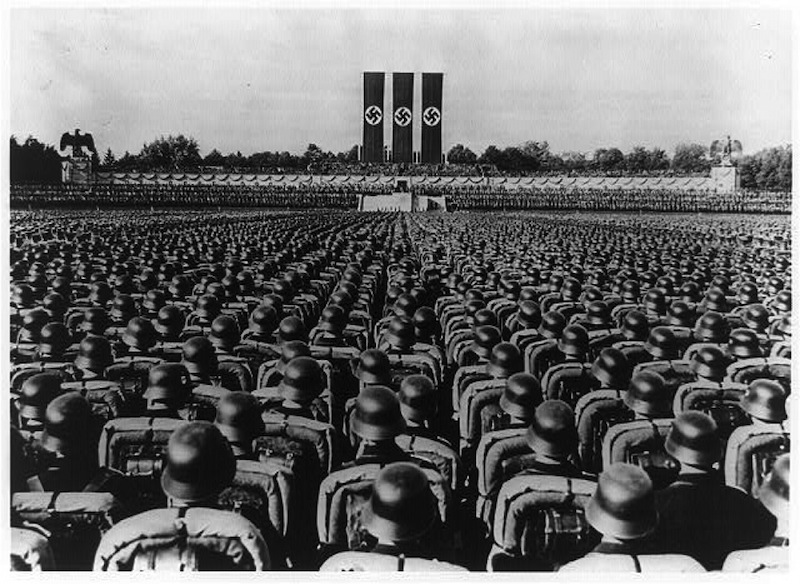
 Was the death of God a liberation for humanity? Or did it simply blow the doors off hell, liberating all its inhabitants.. Above, a modern degenerate myth, the Aryan Master Race (a degraded form of the Chosen People)

             Which brings us to the central theme of this article: are such degraded forms of mythology related in some way to the "death of God" announced a century and a half ago by the Austrian philosopher Friedrich Nietzsche? (See note 1.) Nietzsche's view is contested from various perspectives but it is clear that he was, at the least, merely giving a name to a process of secularization in Western thought that goes back to the Renaissance. That secularization brought us the scientific and technical revolution, the modern concept of citizenry, democracy, the belief in human rights, feminism..The modern world of Progress. However a question remains unanswered for the unbiased observer. If Western thought is no longer guided by Christian theology, who gets to establish the new norms, the new values, the new definition of the Good Life, etc? 

               Religion and culture, claim some anthropologists are social mechanisms which regulate, control and direct human drives and behavior into socially acceptable channels. Religion and culture replace much of the instinctive (genetically programmed) behavior patterns observed in non-human animals. In culture and religion, the human has partially escaped the determinisms of instinct. To some degree, we humans are self-defining, self-determining, self-creating animals. We have, to some degree, escaped the strictures of Darwinian evolution and determine some of the conditions of our own future evolution.

               But what happens when "God" -the dominant cultural and religious system - "dies"-, bcomes inoperant, no longer credible to a growing (and eventually critical) number of people? Certainly, God's death means the end of certainty. It means an interregnum, a period of cultural, spiritual and political anarchy till a new "God" and a new "tables of the Law" rise and once again provide wo/men with meaning, sense, direction.

                In this perspective, the current spate of Conspiracy theories and fake news is the symptom - and the embodiment - of the current state of philosophical, moral and cultural anarchy. These degenerate myths constitute a "regression", in the Freudian sense, to an earlier state of behavioral adaptation. Such states imply that an ecosystem, a society, an organism is experiencing an "existential threat", a life or health threatening situation requiring some sort of creative response (note 2).

                An interesting synchronicity. Just as I was finishing this piece, I received a notice concerning the first article of John Michael Greer's new blog Ecosophia. It treats the same themes I have in pretty much the same way I have above. Such a convergence says something about the zeitgeist - The Spirit of the Age - we inhabit..

 http://www.ecosophia.net/the-twilight-of-anthropolatry/


 notes:

1- http://www.age-of-the-sage.org/philosophy/friedrich_nietzsche_quotes.html

"
.. Nietzsche is concerned about.. relating.. that God is dead in the hearts and minds of his own generation of modern men - killed by an indifference that was itself directly related to a pronounced cultural shift away from faith and towards rationalism and science...

Nietzsche had been raised in an intensely devout and pietistic family atmosphere that he saw as having been unduly restrictive..

 
As an atheist who saw aspects of the influence of the traditions of christianity within which he grew up as having been regrettable Friedrich Nietzsche tended to welcome what he saw as The Death of God!

For Nietzsche a recognition that God is Dead to his own generation of men and women ought to come as a Joyous Wisdom allowing individuals to lead less guilt-ridden lives in a world that was no longer to be seen as being inherently sinful. He considered that earthly lives could become more joyful, meaningful and "healthy" when not lived within narrow limits set by faith-related concerns for the state of an individual's eternal soul.

Nietzsche seems to be suggesting that the acceptance that God is dead will also involve the ending of long-established standards of morality and of purpose.. the possible emergence of a nihilistic situation where people's lives are not.. constrained by faith-based considerations of morality or.. guided by any faith-related sense of purpose.

What are we now to do?

Given what he saw as the "unbelievability" of the "God-hypothesis" Nietzsche himself seemed to favour the creation of a new set of values "faithful to the earth." This view perhaps being associa[ted] with the possibility of the "Overman" or "Superman."


"I teach you the overman. Man is something that shall be overcome. What have you done to overcome him? All beings so far have created something beyond themselves; and do you want to be the ebb of this great flood and even go back to the beasts rather than overcome man? What is the ape to man? A laughingstock or a painful embarrassment. And man shall be just that for the overman: a laughingstock or a painful embarrassment..."

Friedrich Nietzsche ~ Thus spoke Zarathustra"


2- https://en.wikipedia.org/wiki/Regression_%28psychology%29
"Regression: a defense mechanism leading to the temporary or long-term reversion of the ego to an earlier stage of development rather than handling unacceptable impulses in a more [adaptive] way. The defense mechanism of regression, in psychoanalytic theory, occurs when an individual's personality reverts to an earlier stage of development, adopting more childish mannerisms. Psychiatrist Joel Gold suggests that careful use of "ARISE" (Adaptive Regression in the service of the Ego) can sometimes yield creative benefits. To the extent that one is handling thoughts and impulses less like an adult, ARISE involves play, appreciation and primitive pleasures, and imagination."


Wednesday, July 6, 2016

Book Review: toward a Buddhist ecology?

Thom Van Dooren: Flight Ways, life and loss at the edge of extinction: Columbia University Press, 2014; 164 pages, bibliography, index, copious chapter notes, photos.

"..learning to mourn extinction may.. be essential to our and many other species' long term survival"

"Sadly, extinction is not a topic that generates a great deal of popular interest at the present moment. I suspect, however, that in the future to come - if humanity is here at all - extinction will be among the handful of themes that is understood to be central, perhaps even definitional, of our time."
  
"Again and again, we need to ask: What does this loss mean inside its specific multispecies communities? How are "we" called into responsibility here and now, and how will we take up that call?" 

                           whooping crane, North America: elegance in motion

           This is what I call an "angry making" book, the kind that fills me with despair and rage at the human race and its  self-centered stupidity. Prof Van Dooren's theme is extinction of wildlife, what can be done to prevent extinction, and what we are, in fact, doing. The text focuses on the "stories" of humanity's interaction with several avian species: Pacific Island Albatrosses, Australian penguins, Hawaiian crows, Indian vultures, American whooping cranes.

           This book is not an easy read on several levels. The first, and most obvious hurdle, is the academic language (the author is an environmental philosopher and anthropologist at the University of New South Wales, Australia). The lingo is challenging to those unversed in the humanities, especially contemporary philosophy, ethics and anthropology,.. The second hurdle compounds the former:  the "environmental humanities" demand a serious "reframing" of humanity's relation to nature. Such reframings / recontextualizations are never easy! Traditionally, they are associated with major life-crises such as religious conversion: consider the current vogue of jihadist radicalization of Western youth. These people are generally tortured souls. People do not undertake such "conversions" without good reason. They only do so when they understand that the "roadmaps of reality"  of their society no longer correspond to reality, lead nowhere..

           Of course, one can choose not to confront our challenges. We may not have much power, personally, to change things but at least we have the power of this choice. Up to a point, at least, evasion is possible. Some people enjoy spewing hate at imaginary - or real but "demonized" - enemies. Think of the hate-spew of the more fanatical GW deniers, conspiracy theorists or Donald Trump's followers. Or the super-"patriot" who killed pro-European Union British Labour MP Jo Cox:

https://www.theguardian.com/uk-news/2016/jun/18/thomas-mair-charged-with-of-mp-jo-cox 


           I have never been able to embrace the authoritarian mindset, with its black / white dichotomies of "good versus evil", "us versus them", "Absolute Truth versus Absolute Falsehood". My emotional reaction to the fact that the world is going to hell finds no such convenient outlet. At times this has left me quietly frustrated, angry or despairing. Books like prof van Dooren's Flight Ways depressed me so, in the past, I avoided reading them..

The joys of Doomerism

         Recently, given the inability of the world's "leaders" and publics to come to grip with the various demographic, ecological, developmental and moral issues (like the distribution of wealth) we collectively face, I have come to the conclusion that any action we take now will be "too little, too late". The world won't end, of course: humans are mammals and mammals seem to be tough critters. Ancient stem-mammals predate the dinosaurs, surviving two major and several minor mass extinction events. 

          It is even arguable that humans are in so much trouble ecologically and demographically today because of our unprecedented success in the "Darwinian struggle for survival". In this view, we are suffering "an adolescent crisis" because we have not learned to harness the incredible power of our mammalian brains..

        Whether one is an optimist or a pessimist - whether humanity is suffering adolesence or the death agony of an abortive species - there is going to be hell to pay for our stupid mucking around with the planet's "life support systems". So, in this limited sense, I am a doomer - of the "squishy soft" variety because I hope for collapse followed by rebirth / regeneration (footnote 1). 

        Accepting the reality of impending mass human die-off has, oddly, left me less angry and more compassionate. I realize that humans are only doing what 3.5 billion years of Darwinian evolution have programmed our genes and nervous systems to do. Add to this the ecocidal  cultural programming inherited from some 8,000 years of Patriarchy with its ethos of imperial expansion and "plundernomics" (the economics of plunder, pillage and exploitation). 

                          vulture

Towards a Buddhist ecology

          Prof van Dooren is asking no less than a total revision of our worldview: Who / what are we? What is our "place" in Nature? What "functions" do we serve (if any)? What is the value of life (human and other) and how do we prioritize the values of different kinds of life? (And who gives us this "right" to prioritize the lives of others in the first place?)..

         These ain't easy questions! A useful distinction was made by the "Buddhist economist" E E Shumacher (Small is Beautiful, 1973 /1999): questions which have definite, unambiguous answers are "closed questions". Logical or mathematical proofs are good examples of closed questions (and their equally closed answers). If a master mason can build a wall in 2 days and an apprentice in 4 days, how long does it take a master and 2 apprentices to build a wall?

Answer: 1 / (1/2 + 1/4 + 1/4) = 1 day. If you know the trick, you got the answer! (And the answer is always good, 500 years ago or 500 years in the future..) However, the Divinity, one suspects, is perverse because, while relatively easy to solve, such closed questions are generally trivial in nature. Solving algebra problems may be useful (or fun) but the really tough questions, those that tend to keep us awake at night, are generally "open" questions. These questions have to be asked - and answered - anew by each generation and by each individual. Is life worth living? What is the Good Life? What mission is God calling me for? Why am I on this earth? 

         Since Flight Ways deals with open questions, it is decidedly not an easy read. (I speak from my own experience, with no formal training in philosophy beyond Phil 101 and 102.) Despite the difficulty, the book's "message" is worth the effort. I put "message" in quotes to indicate that the author's goal is not so much to convey a body of knowledge than to create within the reader a new way of seeing the world. Decidely a difficult task!

         Flight Ways is an interesting antidote to texts like Barnosky 1, Barnosky 2Reice and  Wilson in which nature is "reduced" to quantitative, economic terms, "parametrized" to fit into equations of ecosystem productivity in order to generate a monetary value. The "value" of a piece of land and its ecosystem can thus be compared to the value generated by a condo development. I have never found this type of calculation satisfying. How, for example, do you calculate the "cost" of a cancer death caused by pollution? By a simple actuarial calculation? The victim's life was, statistically speaking, shortened by X years, the annual salary of the deceased was N dollars, so their death has a value of X times N. OK, I get it, but what about the long term ripple effects of the death? What about the children who never got a chance to go to college because of the loss of the breadwinner of the family? What about the psychological impacts to the family, how do we quantify those in dollar terms? (Does it even make sense to attempt to try to quantify them..) I am not, be it noted, denying a certain utilitarian value of such analyses. For example, in comparing two projects (for, say, an organic farm) involving economic transactions which provide livelihoods for people. "All things being equal" we would choose the project offering the biggest positive (numeric) advantages: net biomass productivity and its commercial value, the number of jobs, the net economic activity created for the local region, ecological impacts.. (note 2)

           However, Flight Ways goes beyond the monetized value of nature to touch other - vital - dimensions of our involvement and contact with nature. In addition to monetary value and "ecosystem service" value, we are asked to consider the being (or, rather, the being-in-the-world, the lived experience of the world) of other life forms. 

           Such a vision or experience of life demands the cultivation of empathy (if not compassion). Hence my reference in the title to "Buddhist ecology". The degree to which such a view is alien to our "normal", contemporary worldview is easily seen in the difficult convoluted language needed to express what to us is not, or no longer, "natural". 

           The following "mission statement" for the series to which Flight Ways belongs, Critical Perspectives on Animals: Theory, Culture, Science, and Law indicates the syntaxic and semantic difficulties occasioned by the required "paradigm shift" in our thinking about our relation to nature.

"The emerging interdisciplinary field of animal studies seeks to shed light on the nature of animal experience and the moral status of animals. Recent work on animals has been characterized by an increasing recognition of the importance of crossing disciplinary boundaries and exploring the affinities as well as the differences among the approaches of fields such as philosophy, law, sociology, political theory, ethology and literary studies to questions pertaining to animals. This recognition has brought with it an openess to a rethinking of the very terms of critical inquiry and of traditional assumptions about human being and its relationship to the animal world. The books published in this series seek to contribute to contemporary reflections on the basic terms and methods of critical inquiry, to do so by focusing on fundamental questions arising out of the relationships and confrontations between humans and nonhuman animals, and ultimately to enrich our appreciation of the nature and ethical significance of nonhuman animals by providing a forum for the interdisciplinary exploration of questions and problems that have traditionally been confined within narrowly circumscribed disciplinary boundaries." 

            One of the things I really liked about Flight Ways is its debunking of "human exceptionalism" especially its silliest, kitschiest manifestations which modern philosophers seem too ready to accept. Prof van Dooren demolishes the ridiculous pretension that "animals like humans experience death but only humans know death". In reality, higher mammals and brainier birds like crows, show behaviors following death of companions which, when seen in humans, are labelled "grieving".

           Another admirable feature of Flight Ways is its recognition - and employment  - of "story" ("narration", "myth"). I can't do better than cite page 10 (emphasis added here and in citations that follow):

 ".. at the same time as they may offer an account of existing relationships, stories can also connect us to others in new ways. Stories are always more than simply descriptive: we live by stories (see footnote 3), and so they are inevitably powerful contributors to the shaping of our shared world. This is an understanding that works against any neat or straightforward division between the "real" and "narrated" world. Instead, I see storytelling as a dynamic act of "storying" the world, utterly inseparable from lived experience and a vital contributor to the emergence of "what is". Stories arise from the world, and they are at home in the world.. 'Worlds are not containers, they are patternings, risky co-makings, speculative fabulations'. Even a story that aims to be purely mimetic can never simply be a passive mirror held up to 'reality'. Stories are a part of the world, and so they participate in its becoming. As a result, telling stories has consequences: one of which is that we will inevitably be drawn into new connections, and with them new accountabilities and obligations.

        And so the bird stories that this book tells / does.. attempt to enact stories as interventions into existing patterns of living and dying in an effort to work toward better worlds." 

                          pacific island albatross and young

          This view of story is akin to the role of myth  in "primitive" religions: the story reveals / creates / participates in the shared "reality" of a human group. Such stories provide constant moral reference points, are sources of shared figures (of speech, symbols, rituals..) Such stories are both empowering and coercive. By contextualizing or framing the self in a larger Whole, "sacred" stories confer purpose, meaning and value on those who enact, literally "em-body", them in their daily lives. Negative narratives - those of dysfunctinal families or demented sects - can do enormous violence and harm, revealing the real power of story / narrative / myth (note 4).

            Without sentimentalization, Flight Ways opens a door to a different vision of nature, wildlife and humanity's relation to these. Rather than assessing the monetary value of species and the ecosytem "services" they provide "for" us, we are asked to consider the lives of other lifeforms as alternative "ways of living". Animals, like humans, are seen as having a subjective core, a "self" with its attendant existential (or phenomenological) "space". Non-human species, like human cultures, express their nature in "ways of life" which provide the necessities for species survival: nourishment, shelter, production and protection of progeny. Seen in this light, we see there is not so much, in essence, that separates us from the rest of the living world! Except, of course, that we humans have, collectively, greater ability to influence the physical environment and the ways of life of other species. In addition, we also possess the gift - or curse! - of being able to see the Big Picture and the role we play in it. (This may be what distingishes humans from the rest of the animal kingdom. We possess the ability to adopt a "meta-perspective" - "outside" of ourselves - from which we view our own actions and their consequences on others..)

             The "Buddhist ecology" - the term is mine, not the author's - proposed by Flight Ways is founded on two bed rock principles: 

1- The "selves" or subjective existences of other life forms, in both their individual and collective aspects, have some intrinsic value. We may, ultimately, choose not to value these subjectivities as much as human (individual or collective) selves, but they still have some intrinsic value (one poorly captured by the notion of economic, monetary or "ecosystem service" value).

2- Existences -life-histories - interact at both the individual and collective levels and across species boundaries. My life is "intertwined" with that of green plants simply because, as an oxygen breather, I depend upon oxygen produced by photosynthesis to live. In practical terms, if humanity "destroys nature", our "intertwining" will assure own destruction.


              These two themes -the intrinsic value of life and its radical interconnectivity - are developed in several chapters which describe the interactions between humans and several avian aspecies: pacific island albatrosses, Australian little penguins, Indian vultures, Hawaiian crows and North American whooping cranes.

             Extinction extinguishes "ways of life" but because the histories of species are intertwined, numerous species are impacted by the extinction of a single species. A simple, but illuminating example: Indian vultures are dying because of veterinarian drugs (to which they are hypersensitive) in bovine carcasses they eat. As vultures have declined, wild dogs have replaced then as scavengers. Result: more people - especially poor people - attacked by feral dogs infected by rabies. Thus the destinies of people, cattle, vultures and dogs are inextricably intertwined in that vast Self-organizing System we call Nature..

             Most poignantly perhaps, Flight Ways discusses how in a time of crisis and extinction, even our attempts to save species involve disturbing moral trade offs and the infliction of suffering, even death. Captive breeding programs may, for example, result in individuals of the species we are trying to save being forced to lead diminished existences in captivity. We are "only" doing harm to serve a greater good, of course, but harm is still being done. This matters if we adopt the "Buddhist Ecological" perspective that all subjective existence - "selfhood" - has some inherent value and deserves respect. Prof van Dooren is not making a general argument against captive breeding programs. Rather he wants to assure that our narratives about "rescueing species from extinction" better serve their goals by increasing awareness of such conflicting entanglements. We will try to provide the captive breeders with "enhanced captivity" perhaps. Likewise, we must pay more attention to the negative psycho-behavioral imprinting in offspring released by such programs into the wild to bolster endangered populations. Negative imprinting, which can reduce reproductive success, is counterproductive to the goal of increasing the reproductive success of the endangered species. Thus, argues the author, science and environmental philosophy should not be seen as enemies but as necessary co-workers whose perspectives can enrich and guide the work and research of the other. 

Inventing new sacred stories. The required "Paradigm Shift" in human consciousness required to re-establish ecological equilibrium on earth promises to be difficult! It will take place only as a result of the catastrophic breakdown of the dominant "Free" Market Paradigm (Note 5). The difficulty is fundamental. It relates to what we consider to be "sacred". I use this term in a sense which englobes its traditional, religious sense but extends that usage to include the attitudes we hold toward the things we consider the most important, valuable, essential or vital in our lives. Many people, today, can be considered as "idolators" of the false god, Profit, The Almighty Buck. This cult incites "ostentatious rank-confirming consumption" to assert our superiority over those who possess less. The worship of Profit (or its derivatives) favors the bottom line of multinationals, stimulates over-comsumption, generates mountains of unsssimilable waste and the attendant environmental crises we now challenged by.

              The difficulty of changing our dominant civilizational narrative to a more life affirming one is made more difficult by the very nature of human nature itself. Contemporary Evolutionary Psychology argues that hypocrisy was a positive survival trait for our species. Basically, humans are not good liars: our eye movements, shift in speaking patterns, etc give us away. From an evolutionary point of view, success in Primate Politics means leaving more progeny. Now chimps - and presumably our early ancestors - have a "machiavellian" psychology so being a good liar means leaving more progeny, a condition which generates positive selection for the character trait of hypocrisy. The highest - most evolved - form of hypocrisy is self-deception: we believe our own BS because that makes us even better liars (since we have convinced ourselves the lies are true!).

            The practical result of this evolutionary history is neither edifying nor encouraging: collectively, we are very blind to the degree to which the narratives we construct to justify our place in the world are false. False - self-aggrandizing / self-justifying - narratives are generally seen when territory has been seized through violence.

              ".. acts of giving are often, perhaps always, premised on prior takings and enclosures, many of which are unacknowledged or deliberately rendered invisible. Thre are obvious connections here to the treatment of indigenous people and more recent immigrants and refugees, who are often similarly positioned as lacking any legitimate claim to places.. " (page 77) 

                 Thus "reserves" are "set aside" for the use of aboriginal populations: an imperialist land grab employing treachery, war, forced religious conversions, ethnocide and genocide is thus miraculously converted into a charitable act. We "reserve" for them a few bits of the land - the least valuable bits - we stole from them.

                           Little penguins, native to Australia, an endangered species


             If you think about it, our attitudes toward the territorial needs of non-human animals are pretty much the same. We set aside reserves. We preserve a piece of wetland and convert the rest to condo development or suburban sprawl. A more Buddist Ecological, which respected the life-narratives of other species, approach would favor high density urban development with high density public transport. Less wetland would need to be "sacrificed" to Profit.

             ".. paying attention to penguins is about listening for alternative and often 'unspoken' stories; it is about learning an appreciation for more-than-human practices of meaning and place-making.. 'narratives remain our chief moral compass in the world. Because we use them to motivate and explain our actions, the stories we tell change the way we acct in the world'. But living well with others can never be about just learning to tell new stories; it must also involve learning new kinds of attentiveness to the stories of others - even if they are unspoken or are told in other-than-human languages. In taking up this approach, I am explicitly rejecting the common notion that narrative is an essentially, and perhaps constitutively, human capacity... But experiencing beings like penguins 'represent' the world to themselves, too; they do not just take in sensory data as unfiltered and meaningless phenomena, but weave meaning out of experiences, so that they, like humans, 'inhabit an endlessly storied world'. These diverse multispecies perspectives play havoc with the simple notion that 'nature is silent', an un-storied landscape awaiting the human inscription of meaning.

             In being attentive to the stories of penguins and others, we help to challenge the closure of human-centric narratives, narratives that along our coasts all too often cover over nonhuman needs and voices. In so doing, we also begin to undermine the obviousness of human understandings and meanings in these shared places, a project that is an essential first step toward ethical relationships.. 'Recognizing earth others as fellow agents and narrative subjects is crucial for all ethical, collaborative, communicative and mutualistic projects.'" (end of citation, pages 78-9) 
 

             This is a difficult book. Its "esoteric" language is definitely off-putting for the non-philosopher. (This was my first impression, at least. With time, I saw the necessity of the unusual language: a new experience of the world necessitates a new language.) We anthropomorphize our pets (too much) yet, for some (? cultural? evolutionary?) reason we cannot extend that empathy to the rest of the living world.

               If I were to attempt to extract a central narrative or story from Flight Ways, it would be, page 43:

"..perhaps we are called to account by nothing less than the entirety of life on this planet, for all the ways in which, during our own brief lives, we help to shelter or destroy the entangled diversity of forms through which life makes itself at home in our world." 

              There! The gauntlet has been cast: choose we life or choose we death? 

              Upon conclusion, I wondered, "is this a despairing book?" I presume, that for some, it is profoundly depressing (or infuriating) - perhaps unreadable. My impression is different. If people, in the depths of our suicidal, hypnotized destruction of our home planet, can rise to pen such words, then there IS hope for humanity. Not necessarily hope for the survival of technical civilization or even the human species itself, but hope in the sense that some inherent, innate, "natural" dignity remains in us. Thank you, Thom van Dooren! 

http://extinctionstudies.org/ 
  
"Again and again, we need to ask: What does this loss mean inside its specific multispecies communities? How are "we" called into responsibility here and now, and how will we take up that call?" 


 notes:

1- One interpretation of the fossil record of life is that of "progress": increasing complexity, capacity to process information, speed of evolutionary change, biodiversity and intelligence.. However, this general story of progress onward and upward is intercut with episodic collapse (mass extinctions), regression and stagnation. Interestingly, the periods of most rapid progress / evolution generally follow episodes of regression and collapse. Human history can likewise be seen as a series of rises and falls of successive civilizations with a general trend towards increased knowlege, complexity and ever greater human population size. Life expectancy is greater now than any time in history in many countries..

2- "Ecosytem services" include a stable atmospheric chemistry permitting and sustaining our metabolic processes: stabilization of levels of essential gases like oxygen - used to "burn" our food releasing vital energy - and carbon dioxide - used by plants to capture and store solar energy in food calories. Other ecosystem services:

- clean water,
- stable regional climates permitting the implantation of high-productivity agriculture, - natural beauty (and its proven therapeutic qualities)
- natural medicines,
- prototype molecules for industrial pharmacology (antibiotics, aspirin,..), 
- natural foods, fibers and construction materials. 

          Nature also provided the wild species from which our agricultural "cultivars" were bred..

http://transparencycanada.blogspot.ca/2016/01/book-review-disaster-ecology-bright.html 

3- "Living by stories": We all do it but for many (?most?) people - seeing the world through ideological / doctrinaire eyes - their own stories / narratives / myths become "invisible". Their particular stories are considered self-evident, revealed or Absolute Truths and hence can never be questioned. In the extreme, all other stories are treated as lies, delusion, heresy or sin. (Personal "Revealed Truths" - not shared by the social milieu - are often classified as insanity today.)

      In such conditions, we can only become aware of the true power of story / narrative / myth by encountering someone - equally dogmatic - whose "foundational stories" are radically different from our own: a modern agnostic / atheist confronting a religious fundamentalist, for example. In these cases we suddenly become aware how powerful stories are in framing, (in)forming and creating (subjective) "reality". The anti-abortion fundamentalist is driven by the Will of God, our Father in heaven, whose will must be obeyed under threat of eternal agony in hell. The pro-choice feminist is just as driven by Ideals of Liberty, Equality and Justice. These Ideals are Absolute Moral Imperatives in much the same way as God's Will is for the fundamentalist. The different stories lead to radically different attitudes, behaviors and life-projects. Such is the power of story / narrative / myth!

4- Functional Magnetic Resonance Imaging (FMRI) brain scans show the functional, dynamic connectivity of the brain. FMRI shows how different parts of the brain are activated and work together when we solve math problems, listen to a favorite piece of music, think of a loved one,.. One of the interesting discovieries is how interesting stories "light up" (neurologically, cognitively) the whole brain. Stories / narratives interact with the brain powerfully and "holistically". This is, presumably, the neurological correlate of stories' holistic, contextualizing properties. Stories that grip our attention exploit and intensely activate the brain's distributed networks:

the neural representation of a concept (sensation, memory) links numerous brains regions and,

conversely, each brain region connects to numerous representations of concepts (sensations, memory). 


Thus even at the neurological level, stories / narratives / myths seem to  create a "whole world image" into which we insert ourselves (by identification with a character). Stories allow us to insert ourselves into the imagined world (perhaps in novel ways), thereby contextualizing ourselves within a larger Whole (which, for major myths like relgions provides meaning, signification, purpose, value).

http://www.abc.net.au/radionational/programs/allinthemind/brain-decoding/7571380 

5- from http://transparencycanada.blogspot.ca/2016/06/book-review-dodging-extinction-part-2.html

  Plundernomics  

The Imperial State, Patriarchy and Plundernomics. To a large degree I follow the schema of social evolution proposed by French sociologist and philosopher of Self-Organization, Edgar Morin.

           Early proto-human and human communities - which cover the quasi-totality of human history! - were small agglomerations (or "packs") of several dozen to (maybe) a thousand indviduals. These were traditional hunter-gatherer (possibly scavenger) societies. They had relatively little social hierarchy (it still existed though!) Democratic decision making was, if not the absolute rule, at least a common norm for these early societies. Men and women, according to travellers, ancient and modern, were more equal in respect, dignity and influence among hunter-gatherers than in "civlilized" societies.

            Around 8,000 years ago (my estimate), a new form of society appeared. Agriculture (grain culture in the Middle East) brought with it sedentarization and the possibility of accumulating surpluses and "infrastructure": controlled territory, fortifications, livestock, and accumulated "surplus labor" in the form of hard currency like trade tobacco, wampum belts, conch shells and soft metals like lead, silver, gold. Military expansion by dominant, militarized clans and tribes permitted even greater accumulation. One grew by stealing from and / or enslaving the neighbors.

             Intensified warfare, of course, bred technological development. Copper weapons conquered weapons of wood and bone. Bronze weilding warriors conquered copper age armies. Then iron conquered bronze.. Centralized power meant steeper and more elaborate social hierarchies; slavery was invented. Trade networks flourished, large towns and cities appeared as well as increasingly specialized forms of labor (professions and artisan crafts). The invention of writing further accelerated the rise of technological mastery by facilitating the acquisition, elaboration and transmission of technical knowledge. 

             In modern times, the acceleration of warfare eventually led to the emergence of science. The great wars of the 20th century carried this process to its ultimate conclusion, producing mutually reinforcing symbiotic linkages between science and technology. Science suggested new weapons (atom bomb), the development of which led to new technologies (the computer, needed to solve the equations necessary to purify bomb grade uranium). Technology, in turn, exapands the reach of science: computers permit astronomers to detect exo-planets orbiting distant stars. This tight, mutually re-inforcing symbiosis between Science and Technology has produced an incredible explosion of knowledge in the last century: nuclear arms and energy, rockets, computers, jet aircraft, space flight, satellite communications, cybernetics, the computer.. 

           Edgar Morin, the philosopher of Self-Organization, refers to the dominant societies in this stage of civilization, now ending, as "Imperial States" or "historical societies" (possessing a written history). I use these terms interchangeably with "Patriarchy" (or "patriarchal cultures"). I have dubbed the dominant economic model of these societies "Plundernomics": economics based on plunder, military expansion and colonization, exploitation in all its forms (woman by man, slave by master, conquered by conquerer, nature by humanity..)

            The latest, most intense phase of plundernomics occurred during the past millennium of world domination by "Christian" Europe. I have found the following chronological schema a useful guide to thinking.

The Emergence, "Fulmination" and Fall of Europe Bourgeois (or "Late Christian") civilization  

Emergence: circa 1150 - 1500 CE. Early rise of modern European bourgeoisie (middle class). Growth of cities, towns and trade. Rising status, influence and power of the mercantile classes. 

Fulmination ("a violent explosion or a flash like lightning"): 1500 - 1850 CE. Discovery / plunder / colonization of the New World, Africa, Asia, etc by European "Imperial States". Absolute domination of the middle class: the American and French Revolutions of the late 18th century were, above all, bourgeois revolutions. The profit of multinational corporations has become our de facto god and the ironclad "laws of the free market" his will / his law. This phase ended with the "commercial circumnavigation" of the globe, circa 1850. Recall: "the sun never sets on the British Empire" (because it was globe-girdling). Post-1850, there were no new lands left to conquer / plunder / colonize, no new resources to squander for the short term profit of the bourgeois elite and their Frankenstinean creation, the multinational. Bourgeois civilization had reached its "Limits to Growth" - the end was now in sight!

Decadance and Fall1850 - 2200 (??) CE. With an obselete economic model - plundernomics, Bourgeois civilization must either 1- die or 2- mutate into something different than it is now. Either way, the poo is in the fan: a Time of Troubles when the old roadmaps of reality no longer work.

          The most recent avatar of plundernomics has given us the (hyper-)"consumer society". In this pathological, overstimulated economy, the reckless consumption of goods and services substitutes for

- addressing the real, urgent problems facing society and
- developing meaningful relations with self, others, society and the natural world.

           The ruse is actually quite clever when you start deconstructing it! Consumer "society" substitutes externally programmed "secondary drives" (pathological consumption of unnecessary stuff) for real significance embodying activities and relations (primary human drives or needs). This swindle creates a (theoretically) endless demand for industrial junk no one really needs (!!) What a scam! Can't beat that one (only religion at its worse can come close). Because, you see, since primary needs (self-expression through work, shared endeavor, love, a sense of meaning or purpose in life, capacity for wonder..) are not being met by consumerism, frustration remains in the core of the person. This frustration is then manipulated by commercial promotion to stimulate still more (over-)consumption of junk one does not need. It's the typical addictive cycle of the junkie or hypoglycemic sugar addict. The "fix" wears off fast and one needs another "boost" soon enough (which, of course, keeps the wheels of industry rolling and over-inflated bottom lines and CEO perks roiling..) 

              "Ostentatious rank-assigning consumption" feeds off the human need (like other mammals) to define a social status for oneself. Ostentation consumption substitutes for personal worth and merit in determining one's social rank. "I consume more than you therefore I am better than you!". Social rank assignment becomes a totally negative exercise. One is not honored for ones accomplishments but by the negative (demeaning, degrading) compasison with another, less fortunate or entitled, than oneself. The modern West has deviated very far indeed from the ideals expressed in the French and American Revolutions: freedom, equality, fraternity!